Friday, April 30, 2010

Book Review: Savor The Moment

Sometimes when I finish a book, I can't help but feel that the experience has made me better in some way.  Maybe that sounds really cheesy, but it's true.  That's one of my favorite things about reading great classic literature: it just leaves you awestruck.  I loved the wildness of Wuthering Heights, the subtle, brilliant emotions of Jane Eyre, the intricate story of A Tale of Two Cities, and the straight-up genius wit of Les Liaisons dangereuse.  There are modern writers who can move me, too, like in My Sister's Keeper.  Avid readers know this.  This is why we read.

And then there are some books that, after you read them, you feel like part of your brain has been lobotomized.  I give you Nora Roberts' Savor the Moment
                                             
Maybe that sounds harsh, but I think it's justified.  I like Nora Roberts, I really do.  I've read almost all of her books.  I've come to expect a formulaic, predictable story from her, but I'm okay with that.  Hell, that's precisely why I read the romance genre in general.  What I'm not okay with her trying to sell me shit.  And I'm sorry, but that's what she's doing in this Brides Quartet.

I wasn't particularly kind to the last installment in this series, Bed of Roses, but again, I was justified.  Emma was effing annoying, and the way that Roberts expected the reader to accept that her behavior was rational and not insulting to all women was insulting to all women.  I had hopes that the rest of the books would be better because my biggest problem with Bed of Roses was Emma's perfect life.  Laurel, the heroine in Savor the Moment, is not perfect.  But does Roberts delve into Laurel's issues in any depth?  Does Roberts show us ANYTHING about Laurel outside of her love for the hero, Del?  No.  Seriously, guys, she doesn't.   Laurel apparently has a background that I would have liked to learn about.  But I never got that chance.

(I will now segue into a letter to Nora Roberts.)

Come ON, Nora.  It's bad enough that you're writing four books about freakin' weddings.  As if the wedding industry in this country isn't absolutely ridiculous in the way that they put all the focus on ONE DAY, you give us four women that make their livelihood out of catering to these self-absorbed people.

**SIDE RANT**  Not only that, but you present them in a REALLY annoying way.  These women never make freakin' mistakes.  EVER.  They always know exactly how to talk down a bride, or exactly which flowers they'll like, or exactly what cake they'll want.  Every.  Single.  Time.  Throw in some screw-ups every once in a while and we'll talk.  The worst is Mac, the photographer.  This woman sounds like the kind of photographer that makes me hulk out.  In the first book she did a pregnancy session where she made the pregnant lady get naked.  Anyone who knows me knows I hate those kind of pictures with a passion that will never die.  And I'm sorry, Nora, but it sounds like Mac has little to no imagination as a photographer.  The bride is a florist?  Let's shoot her in a garden!  The groom is an English teacher?  Let's shoot him with books!  The couple met as children and shared a fondness for cookies?  Let's shoot them with cookies!  Please.  I know wedding photographers that do amazing, amazing work and never result to that unimaginative shit.

But your worst transgression is the complete and utter failure to portray these women in a real way.  They are obsessed with weddings, and in Savor the Moment particularly, there is nothing to Laurel other than her love of Del.  Even when the four friends are together, all they talk about is work or relationships.  Oh, yeah, and sex.  These bitches NEVER SHUT UP ABOUT SEX.  When they have it, they have to make mention of it.  When they're not having it, they make mention of the others having it.  Seriously, I don't know women like this.  Don't they ever talk about important stuff?  Current events, the economy, feminism, celebrity gossip, books they've read, etc?  Nope.  Just men.  And weddings.  And sex with men.  This is an insult to women, Nora.

Look, I get that you've got a theme here.  Each woman in this series needs to get a man in each installment of the series.  But for the love of God, what is wrong with dating for a while?  Emma and Laurel were with their respective men for about two months tops before they're distraught over whether or not the men want to be with them forever.  For fuck's sake, what is the rush?  And why can't a couple admit that they're in love more than five minutes before a marriage proposal?

As you can tell, I did not like this book.  At all.  But I will still read the last book, because I'm a masochist.  And an optimist.  Parker, the last heroine to be paired up, has the potential to be more multi-dimensional than all her friends. She also comes across as truly independent and strong, unlike her man-crazy friends.

But Nora, you've gotta step it up.  You're getting lazy, here.  Don't think we haven't noticed.

Lindsey's Grade: D

Movie Review: The Girl With The Dragon Tattoo

All of you readers out there: how often is it that you go see the movie version of a book you've read (and liked) and leave the theatre thinking, "Wow, that was great?" 

I don't know about you, but that is not a common occurrence for me.  What is even more rare is enjoying the book better because of the movie.  But that is exactly what happened when I walked out of the theatre after seeing The Girl with the Dragon Tattoo

I had mixed feelings about that book.  I like it, liked the story, but I wasn't crazy about the writing.  I didn't connect to the characters as much as I would have liked.  If you had a similar experience with this book, then you need to see the movie as well.  Because there are some things that have to be seen and not read.

There are some pretty intense things that happen in the book, mostly to Lisbeth Salander.  Lisbeth is a really unique character, but I had problems connecting with her because she seemed like an automatron a lot of the time.  As a result, I read these intense scenes with kind of a detached attitude.  The movie makes that impossible.  Seeing what happens to Lisbeth in such graphic detail really enhanced her character for me.

Also, the movie (it is a Swedish production, so subtitled in the U.S.) does an excellent job of sticking to the book.  Sure, there are things that are omitted and changed, but nothing that detracts from the story.  And all the important details are still there, I think.  Because they got that right, the movie ends up being a wonderful complement to the book.  Honestly, I think you need to see the movie to fully appreciate the book.

What pissed me off, though, are the rumors that Hollywood is going to do a version of the story.  There is even an imdb entry that has Carey Mulligen rumored to be playing Lisbeth Salander. 

No.  No, no, no.  That is just wrong.  WTF, Hollywood?  Lainey over at Lainey Gossip put it best.  Just leave it alone, Hollywood.  The Swedes already did it, and they knocked it out of the park. 

Wednesday, April 28, 2010

Book Review: The Girl Who Played With Fire

Okay, Stieg Larsson fans, was anyone else pissed about the ending of this book?  I'm sorry, but if I'm going to spend my entire morning finishing a book instead of doing all the homework and writing all the papers I need to, then I expect to get some fucking closure.  (Pardon my French.) (Also, didn't you used to be able to wrap text around images on Blogger?  What am I doing wrong?  I cannot figure this out for the life of me.)
As far as the Millennium books go, I am torn on which one I like better.  I don't think I would necessarily say that The Girl Who Played with Fire is a better book, or even a more interesting book.  I much preferred the mystery of The Girl with the Dragon Tattoo.  But at the same time, I found this book more enjoyable to read.  

I gotta tell you, though, I'm a little worried for The Girl Who Kicked the Hornet's Nest or whatever the heck the third book is called.  If it ends as abruptly as this book, I am going to be pissed, because Larsson is dead, that's the last book he wrote, and I need my goddamn closure.


Thursday, April 15, 2010

Book Review: The Girl With The Dragon Tattoo

There is hardly a literary bandwagon I don't jump on at some point in time.  I may not have read Harry Potter until long after Deadly Deathly Hallows was published, but I got there eventually.  Same goes for Twilight.  So of course I had to jump on the current Millennium trilogy bandwagon, too.  

I used that book cover because that is what my copy of the book looked like.  I bought my copy in the Amsterdam airport because I'm just THAT cool.  Okay, not really.  If I were really cool, I would have known that I should have bought the last book in the trilogy because it was just sitting there on the table in the airport shop, available for purchase.  Because guess what?  The third book is not available in the United States yet.  Damn it!  I lost my chance.  

Oh well.  It's not such a bad thing because, to be honest, I'm not nuts about this series.  Don't get me wrong, I enjoyed The Girl with the Dragon Tattoo, and I didn't guess the ending (which is always nice in a mystery).  I'm even reading the second book right now, The Girl Who Played with Fire.  But I'm not really having any kind of emotional reaction or attachment to these books or to the characters.

I think part of the problem is the language barrier.  My favorite books tend to be ones written by American, British, or Australian authors, mostly because I like to read books in their original language, and I am embarrassingly monolingual.  Nevertheless, some books are beautifully, effortlessly translated.  Les Liaisons Dangereuse blew me away; I never would have guessed it wasn't originally an English-language book (other than the fact that that author is French, it is entirely set in France, and the characters are all French, of course).  But other times translated books come across as dry.  Sadly, I'm putting The Girl with the Dragon Tattoo in this category.  In my opinion, it read like a book translated into another language.

But aside from the translation, I think that I'm just not a big fan of the mystery genre.  I like characters and character-driven stories.  I think that mystery novels are, by their nature, more plot-driven.  Even though the two main characters of the Millennium trilogy, Mikel Blomkvist and Lisbeth Salander, certainly are three-dimensional and interesting, I just feel like thus far in the series it's been more about what they do than who they are.  Maybe that will improve as I continue with The Girl Who Played with Fire.  I'm slightly optimistic.

Also, did anyone else who read this book feel like it took more than half of the book to really get the story moving?  I felt that way. 

Friday, April 02, 2010

2010 so far + A poll

Hey there! It's Jen! I'm not much of reviewer, so I'm going to keep this short.

Books I've read so far in 2010, and a one word review:

1. Special Topics In Calamity Physics by Marisha Pessl GREAT!
2. Nanny Returns by Emma McLaughlin & Nicola Kraus Eh...
3. The Greatest Disaster Stories Ever Told Terrifying!
4. The Blind Assassin by Margaret Atwood Strangegood
5. The Believers by Zoe Heller Overworked
6. I Drink for a Reason by David Cross Egotistical
7. Speak Up by Cyndi Maxey Informative
8. The Little Book by Seldon Edwards Betterthanithoughtitmightbebasedonthedescription
9. Forever by Pete Hammil Interesting
10. Man or Mango? A Lament by Lucy Ellmann Quirky

Currently reading:
Man out of Time by Michael Hogan

Now, the poll: (which I expect at least ONE person to reply to?)
Last year about this time I dove into Les Miserable - so I'm thinking it's time to hit the classics again. I'm debating between two longish ones, and thought I'd get an opinion, if anyone has read them both.

(side note, anytime i delete anything and then start typing again, it's in BOLD. i'm getting sick of changing it.)

Anyway: Option one is Vanity Fair, and option two is The Count of Monte Cristo. The thing is, I've already read the second one, but really really liked it, so I kind of want to read it again. But, should I try something different? Anyone?

Alright. Happy "spring" (she says as it snows outside for the second straight day in APRIL.)

Ta ta!

Wednesday, March 31, 2010

Book Review: The Monsters of Templeton

I'll just come out and say it: The Monsters of Templeton is an enjoyable book, and I recommend it.  I found it engaging and easy to stick with from beginning to end.  The book is essentially the story of Willie Upton, a young woman who returns home to Templeton, New York, after she has an affair with one of the married professors in her graduate program.  While she's home, she learns for the first time that her father is not who she thought he was.  Well, she never knew her father, but she had always been told that it was one of three men that her hippie, teenage mother slept with in a San Francisco commune.  As it turns out, that was a lie.  Her real father is someone from Templeton.  While she's biding her time back home, Willie decides to set out and find out who her real father is.  All her mother will tell her is that he is a descendant of Marmaduke Temple, the founder of the town.

A little background: Groff is from Cooperstown, and she essentially models Templeton on Cooperstown.  I've never read any of James Fennimore Cooper's work, but apparently some of it is set in Templeton?  I don't really know, but I think it was very clever of Groff to write about her hometown in this way.  Willie and her mother are legitimate descendants of Marmaduke Temple and his son, the famous American author Jacob Franklin Temple (Fennimore Cooper's fictional counterpart, obviously).  They're also illegitimate descendants through the slave that Marmaduke fathered a child with.  When Willie finds out that her biological father is also an illegitimate descendant of Marmaduke, she understandably wants to find out where that branch of the family tree budded from---if for no other reason than to assure herself that's she's not a complete inbred.  So Willie devotes her summer to researching the family history and finding which adulterous ancestor spawned her father's lineage, hoping to work her way down in order to identify her father.  

From that point on, the book alternates between historical accounts, diaries, letters, etc, of various Temple ancestors.  There are a number of interesting stories that are told along the way.  All very entertaining.  the only downside was that Willie was very hard for me to relate to, but she was still very likable.  I think that is attributable to Groff's skill as a writer.  I think I read in the reading guide at the back of the book how Groff wrote Willie thinking of the kind of wild, adventurous girls she always admired from afar.  After reading that, I was able to view Willie in a more favorable light.  I don't know why, but that made a difference.  I guess I could accept Willie's faults easier knowing that Groff wasn't necessarily advocating or condoning her actions, just writing about a character.  (Funny how that's hard to do.  I think that's what sets me apart from writers.  I have a hard time writing about things I don't know or don't like.  Again, a testament to Groff's talent.)

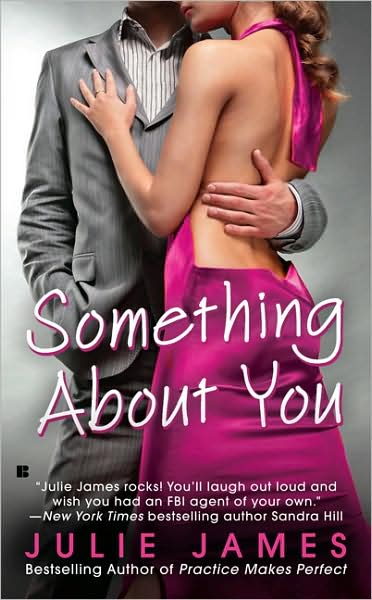
Book Review: Something About You

I first heard about Julie James's Something About You through the "Save the Contemporary" promotion over at Smart Bitches.  I kept hearing all sorts of positive reviews so I decided to give it a try.  I actually really like contemporary romance novels---when they're done right.  And this one was done right.  (I don't know how to fix this space...)
The heroine, Cameron, is an Assistant United States Attorney.  As a lawyer myself, it is sometimes frustrating to read about characters who are also lawyers because sometimes it is just so poorly done.  See Christina Dodd, Trouble in High HeelsHowever, I think Julie James is a lawyer herself, so she knows what she's doing.  And as someone who worked for a federal public defenders office for a year, I can attest that she knows what she's doing with an AUSA.

Hero, Jack, is an FBI agent who used to work with Cameron years ago until she dismissed one of his cases and he bad-mouthed her to the media.  His punishment was to be transferred from Chicago to Nebraska for three years.  But when he moves back to the Chicago office, the two of them run into each other again.

The way Jack and Cameron's story was set up really worked for me.  I like that they have a history together.  Too often in romance novels the relationship moves so quickly that it is hard to believe it.  By assuring the reader that the characters know each other well from a multi-year professional working relationship, it makes their eventual romance seem genuine and believable.  

Also, the action/mystery aspect of this book never overshadowed the romantic relationship; it flawlessly moved it along, however.  I've read enough books to know that that is not always easy to do.  For all of these reasons, I'm really impressed with Julie James.  My biggest complaint about contemporary romance novels is that the heroines are usually not very intelligent.  I think that Nora Roberts' success is due in large part to the fact that she knows how to write an intelligent female character.  Even though I really like Rachel Gibson's writing, I usually don't like her heroines because we usually hear more about their shopping and clothes habits than their smarts.  Cameron is a great balance.  I think that's due in large part to Julie James's own education and intelligence.  Jack is great, too.  A fun book!

Saturday, March 06, 2010

Mullet City!


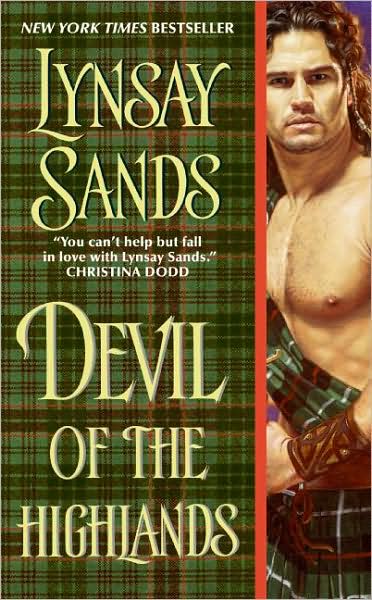
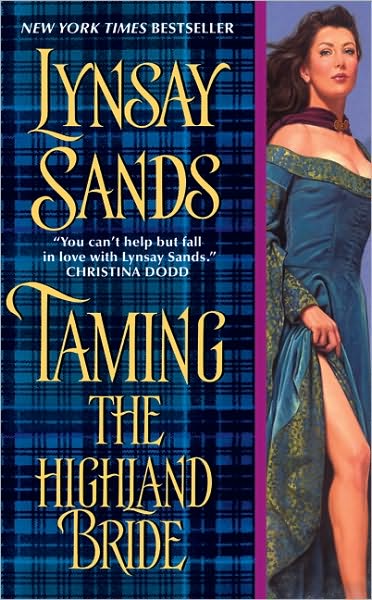
I would really like to know what Lynsay Sands did to piss off the art department at Avon.  Seriously, look at the hairdos on those men.  Mullet.  City.  I wish I could find the inside cover art online, so you could see how much worse it gets.  Taming the Highland Bride's inside cover doesn't escape the horror, either.

I don't get it.  Is there some kind of historical record that establishes the popularity of the mullet in 13th century Scotland?  (Or whatever century these books are set in?)

It's really a shame.  I've only read one of Sands' books (Devil of the Highlands), and it was pretty good!  Poor lady doesn't deserve the awful cover art.

Saturday, February 20, 2010

Book Review: Testimony

Anita Shreve is one of my favorite authors, and I bought Testimony shortly after it was released, but I didn't get aroudn to reading it until now.

Each chapter of this book is written from the perspective of one of the multiple characters.  Most chapters are written in first person, some in third person, and there's even one written in second person.  Each character is giving their testimony of the events that surrounded a sex scandal at a private secondary academy in Vermont.

The problem with this book centers on the sex scandal. It starts when Mike, the principal, is given a videotape that was filmed in one of the dorm rooms.  In the video, a fourteen year-old female student performs oral sex on an eighteen year-old male student, then she has sex with another male student (who is either seventeen or eighteen), while a nineteen year-old males student watches and masterbates.  Everyone appears to be drunk.

Yes, it is statutory rape, and that is a crime, but I just had a really hard time accepting the magnitude of this scandal.  Shreve describes it as so big and receiving so much media attention that Anderson Cooper and Brian Williams types camp out at the school.  One characters recalls that the small town of one thousand doubled in population.

Come on.  Even if the scandal was compounded by the school's attempt to keep it quiet, I don't think a reader can reasonably be expected to believe in all this.  I went to a private boarding academy, and sexual stuff went on all the time.  There were even some crimes committed, and we didn't even get local news attention.

This was disappointing to me, because it really affected my ability to enjoy this book.  What I love about Shreve is how much she can convey with her simple style of writing.  Body Surfing is an excellent example of this.  Also, I just had a hard time connecting with her characters in Testimony.  I didn't feel the emotional connection like I did in Light on Snow, for instance.  This is not one of her best works, in my opinion.  If you've never read Shreve before I would recommend starting with Body Surfing, Light on Snow, Resistance, or Fortune's Rocks.

Saturday, February 13, 2010

Book Review: Ravishing In Red

Oh, yeah, I forgot that I read this book, too.  Not bad, but not great, either.  The plot is coherent and kinda interesting, so that's a plus.  The characters are believable and likable, another plus.  But for me, no emotional connection.  Bummer.  I'm kind of intrigued by the next book in the series though, Provacative In Pearls.  (I know, ridiculous titles.)

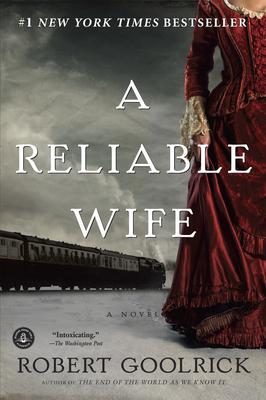
Book Review: A Reliable Wife

This book... confuses me.  I wish I could take a picture of the back cover so you could see the description and reviews that made me super eager to buy this book.  "Thrilling," "suspenseful," "intoxicating," etc, etc, etc.

Seriously?  No.  (And I'm not alone.  The customer reviews at Amazon.com are all over the map.  Some love it and some, like me, thought it was pretty bad.)

The description is what sucked me in.  Ralph Truitt is a lonely man who places an add for "a reliable wife."  The woman who responds, unbeknown to him, plans on killing him and taking his money after they wed.

I'm a sucker for shit like that, what can I say?  And in the hands of one of my favorite romance novelists, I think it could have been a damn good story.

But this was not.  The writing, my God, the writing.  It is praised and praised and praised, but I thought it was not very good.  It just felt forced, like the author was trying really hard.  A lot of the negative customer reviews at Amazon.com point out that it is repetitive, and YES, it is!  And really, this book is ALL about sex.

Ralph is simultaneously obsessed with sex and celibate for twenty years.  Maybe that's not so contradictory, but the way Goolrick writes it, it seems that way.  We hear all about what a libertine Ralph was as a young man.  But we also hear all about how he is convinced that his lust is evil because he uber-religious, crazy mother told him so as a child.  Now that I thought made no sense.  There's no indication that Ralph believes anything else his mother ever told him, or anything else about religion, yet for some reason he's had this skewed view of sex his whole life.  But even though he thinks it's evil and will only hurt people, I wasn't sure how that supposedly affected him.  He's promiscuous as a young man, then goes completely celibate after losing his wife.  Then when Catherine, his new wife, arrives he is again obsessed with sex.  I don't know, it just all felt very disorganized and contradictory to me.

Catherine was certainly more likable, but she was utterly predictable.  As was the plot.  There were no shocking twists and turns, despite what the reviews say.  There were a few things held back from the reader, but they didn't blow my mind when they were revealed.   

Let me just give you an example of what I'm talking about as far as the sexual obsession and not-so-good writing goes:

He wanted to slice her open and lie inside the warm blood of her body.

Jesus.  What the fuck is that?  That shit is straight out of Star Wars.

In the end, I guess I just can't enjoy a book that's essentially about the constant sexual thoughts of a fifty-some year old man.  Ick.  This book is not very original and not well-written.  I'm really, really pissed that I bought this one instead of Roses.

Book Review: Into The Wilderness

When I first started reading this book, I was really excited.  I went to the bookstore in the mood to read an epic romance, and this book pretty much fit the bill.  As a bonus, it's loosely based on The Last of the Mohicans, and who doesn't wish they were Cora to Daniel Day-Lewis's Hawkeye?  I DO.

Into the Wilderness is the story of Elizabeth Middleton and Nathaniel Bonner.  The book is set in late eighteenth century New York state. Elizabeth's father is a judge and landowner in the small town of Paradise.  Elizabeth was raised in England by her father's sister, but she and her brother move to America to live with their father when Elizabeth is twenty-nine.  She plans on starting a school in the town, but until she arrives she doesn't know that her father plans on her marrying Richard Todd, a wealthy doctor.  The judge has worked out a plan that when Elizabeth marries Richard, he'll deed a portion of his land in return for Richard paying off the judge's debts.  But Elizabeth isn't too keen on that plan, especially after she meets hunky Nathaniel Bonner.

Nathaniel's father's name is Daniel Bonner, but he goes by Hawkeye.  His wife was Cora, and his father is Chingachgook.  That's about it as far as The Last of the Mohicans go.  But from the physical descriptions of Nathaniel, I think it's safe to say that Sara Donati had Daniel Day-Lewis in mind.  Anyhoo, the Bonners and their Mohican family happen to live on the parcel of land that is at issue in the wedding plans.  When Elizabeth and Nathaniel develop feelings for each other, they hatch a plan to pull a fast-one on the judge and Richard: Elizabeth will pretend to agree to marry Richard, and thus she'll sign the deed giving her the land.  But in the small window between the conveyance and her wedding, she'll elope with Nathaniel.  After their marriage, the land will go to her husband.

I'm not giving anything away by telling you that they carry out their plan.  And then the book goes on.  And on.  And on.

Not that that's necessarily a bad thing.  I was certainly interested and entertained the entire time I was reading.  There is plenty of action moving the plot along.  But I was a little disappointed because I never really became attached to Elizabeth and Nathaniel.  I cared about them, but their love story didn't move me.  Elizabeth comes very close to being too perfect to like.  She does have one MAJOR screw-up that I think was well done on Donati's part.  (It makes me think she knew readers were going to dislike this lady if she continued being perfect.)  But all in all the book is well-written, consistent, and enjoyable.  It just didn't capture my emotions.  Bummer.

Thursday, February 04, 2010

Book Review: The Elusive Bride

Stephanie Laurens is an auto-buy author for me.  I buy her books no matter what they are about.  Her books aren't always great or the kind of story that I will remember and re-read, but I pretty much always enjoy the reading experience.  There are some romance novelists that seem like lazy writers to me, and I would never put Laurens in that category.  Her books may be very similar to each other, but I can usually tell that she has put serious thought into the plot.

So I'm a little disappointed to discover that I didn't really enjoy reading The Elusive Bride.  It's a bummer because I was really looking forward to it as it is the second in her Black Cobra quartet and the sequel to The Untamed Bride, which I enjoyed.

Laurens does step outside of her formula a bit in The Elusive Bride, so maybe that's what did it.  Instead of being set entirely in England, the books spans the characters' journey from India to England by land and by sea, and thus there was considerable focus on the journey and events along the journey instead of the romantic relationship.

I gave a synopsis of the basic plot of the quartet when I reviewed The Untamed Bride, so I won't repeat it.  Suffice to say that the Black Cobra cultists are chasing the heroes of the books because the heroes have something they want.  That's fine, I get it, but The Elusive Bride is pretty much nothing but cultists attacking the traveling party again and again and again, always unsuccessfully.  Not a single member of the traveling party perishes and only one is ever injured.  Boooring.

There were a few deviations from the standard Laurens' formula when it came to the characters, I suppose.  Gareth, the hero, came across as a little more vulnerable than her traditional alpha hero.  He was not the pursuer, the way Laurens' heroes usually are.  That should have worked for me, but I don't think Laurens fully exploited the opportunities she set up there.  Something about it just didn't feel right.  I think it might have been that the reader didn't know enough about Gareth to really connect with or understand him.  The heroine, Emily, was very likable, I thought.  And the reader got to know her well.  But again, something was missing, and I think it was genuine conflict.

This is a romance novel, as such, standard genre elements should be followed (I think.)  The conflict in this book was all about the traveling party being attacked by cultists.  Any conflict between Gareth and Emily felt forced or contrived.  Definitely not genuine.  Also, Laurens kind of deviated from her usual sex scenes, too.  They seemed much shorter than usual.  That's not necessarily a bad thing (as she tends to overdo it in that department), but it just made it feel even less like a Laurens' book.

Finally, after reading The Untamed Bride, my sister complained about the misleading title.  The same thing happens here!  Emily is the pursuer in the romance, no question about it.  The whole relationship aspect is predicated on her determination to discover if Gareth is "The One" for her and then convincing him that she is "The One" for him.  Not exactly my definition of "elusive."

Some Thoughts On Series and Sequels

A week or so ago I found myself wanting to read a book but not just any book.  I wanted to read an epic or adventure story.  One that spans time, geography, etc.  And of course, one that features some kind of love story.

It was kind of a weird urge to suddenly have such a specific desire for a book, but I had just finished re-reading Shanna by Kathleen E. Woodiwiss, and that book is kind of epic.  I freakin' love it, and wanted something similar.

The problem is, those kinds of books are hard to find in the romance section of a book store.  Historical romances these days tend to be pretty limited to the courtship stage, and they're usually all set in England, where the characters stay.  Besides, it's been a while since I read a genre romance that I really enjoyed.  So when I went down to my local Barnes & Nobles looking for something, I just walked around the Fiction & Literature section until something caught my eye.  I ended up with Sara Donati's In the Wilderness, which was pretty much exactly what I was looking for.  Yay!

Now, I'm still reading the book so I will review it later, but since starting it I've discovered that there are at least five other books in this "series."  And for some reason, that bothers me a little bit.

I'm not sure how to explain it exactly, but sometimes the knowledge that the story is going to go on and on is kind of . . . disappointing.  Sometimes it's better to introduce a reader to the characters and then end the story somewhere, after which the reader's imagination can take over.  The more an author tells us about them after the initial happily ever after, the more likely it is that the author will take the characters somewhere I don't want to go.

Does that make sense?  It's almost like a soap opera in some ways.  The best example I can think of comes from Days of Our Lives.  I used to watch that show a lot.  And for years one of the big stories was Austin and Carrie.  Austin and Carrie loved each other, but Carrie's sister Sami tricked Austin into bed and got pregnant.  After that, Carrie had to watch the man she loved with her sister, and Austin was stuck with a woman he didn't love.  This went on and on, and viewers like me just wanted Austin and Carrie to get together, until finally it was revealed that Austin's brother Lucas was the real father of Sami's baby.  Sami was a rotten liar, and Austin and Carrie could finally get together.  But it's a soap opera, so happily ever afters aren't allowed.  Conflict is interesting, so no long after Austin and Carrie's love story was finally realized, Carrie leaves Austin for Mike Horton.  WTF?

The same goes with books.  If an author is going to continue his/her characters' story into another book, then he/she is going to have to put some conflict in there in order to make it worth the read.  But then that just makes the previous books' happily-ever-after feel . . . ruined, to some extent.  See Meg Cabot, Queen of Babble in the Big CityI just feel like the more details you add to the sequel, the more you take away from the original reading experience.

This is one reason why I think many epilogues in romance novels are limited to showing how the hero and heroine have gotten married and had children.  There was a very legitimate commentary on Smart Bitches about how happily-ever-afters in romance novels are often conditional on having children (looked for the post but couldn't find it to link to), but in some ways, that's not such a bad way for an author to go.  It shows the reader that the characters' lives are evolving, but it is generic enough that it doesn't restrain imagination.

For me, it just comes down to less being more.  When I finish this story about Elizabeth and Nathaniel, I'd like to believe that they are able to live out their lives happily.  But from what I've read of the next book, it sounds like there's a whole lot more hardships for them to go through.  Ugh.

Finally, I will just add that I think this is in part what is being my disgust of Pride and Prejudice sequels.  I'd like to leave Darcy and Elizabeth's life together to my imagination, thanks.  I don't want anyone writing about how it turns out he's a vampire or whatever.  That just takes away from the original.  And, it's dumb.  (Don't even get me started on this shit.  If ever there was a need for perpetual moral rights in artistic works, THIS IS IT.)

Sunday, January 17, 2010

My Year in Books 2009

I'm stealing the idea of posting all the books I read in 2009 from Jen. By my count, I made it to fifty-two, so one book per week!  I would feel a lot better about that if the majority of them weren't easy-to-read romance novels...

1. The Tenant of Wildfell Hall by Anne Bronte
2. Jane Eyre by Charlotte Bronte
3. Rebecca by Daphne du Maurier
4. Supreme Courtship by Christopher Buckley
5. Les Liasions Dangereuses by Pierre Choderlos de Laclos
6. On Beauty by Zadie Smith
7. Sense and Sensibility and Sea Monsters by Ben H. Winters
8. Birdsong by Sebastian Faulks
9. The Physick Book of Deliverance Dane by Katherine Howe
10. Sarah's Key by Tatiana De Rosnay
11. Run by Ann Patchett
12. A Thousand Splendid Suns by Khaled Hosseini
13. Mistress of the Monarchy by Alison Weir
14. Pride and Prejudice and Zombies by Jane Austen and Seth Graham-Smith
15. The Purity Myth by Jessica Valenti
16. A Tale of Two Cities by Charles Dickens
17. The Trial of Queen Caroline by Jane Robbins
18. Overthrow: America's Century of Regime Change by Stephen Kinzer
19. The Seven Ages of Paris by Alistair Horne
20. Beyond Heaving Bosoms: The Smart Bitches' Guide to Romance Novels by Sarah Wendell and Candy Tan
21. Let It Be Love by Victoria Alexander
22. A Visit From Sir Nicholas by Victoria Alexander
23. Smooth Talking Stranger by Lisa Kleypas
24. Seduce Me At Sunrise by Lisa Kleypas
25. Indiscreet by Caroline Jewel
26. Scottish Brides Anthology
27. Memoirs of a Scandalous Red Dress by Elizabeth Boyle
28. Confessions of a Little Black Gown by Elizabeth Boyle
29. The Untamed Bride by Stephanie Laurens
30. Mastered By Love by Stephanie Laurens
31. Temptation and Surrender by Stephanie Laurens
32. First Comes Marriage by Mary Balogh
33. Then Comes Seduction by Mary Balogh
34. At Last Comes Love by Mary Balogh
35. Seducing An Angel by Mary Balogh
36. A Precious Jewel by Mary Balogh
37. Smoke Screen by Sandra Brown
38. Vision In White by Nora Roberts
39. Black Hills by Nora Roberts
40. Bed of Roses by Nora Roberts
41. What Happens In London by Julia Quinn
42. To Beguile A Beast by Elizabeth Hoyt
43. To Desire A Devil by Elizabeth Hoyt
44. True Love and Other Diasters by Rachel Gibson
45. Written On Your Skin by Meredith Duran
46. This Duchess of Mine by Eloisa James
47. A Duke of Her Own by Eloisa James
48. By Love Undone by Suzanne Enoch
49. Always a Scoundrel by Suzanne Enoch
50. Blue Smoke and Murder by Elizabeth Lowell
51. Death Angel by Linda Howard
52. The Temptation of the Night Jasmine by Lauren Willig

Sunday, January 10, 2010

Random Romance Reviews


I thought I'd write a quick blog to review the books I read over the Christmas holiday.  First up: Believe by Victoria Alexander.  Now, Alexander is a writer I enjoy.  I am almost always pleasantly surprised after I read one of her books.  So even though Believe is a re-issue, her name alone was a selling point for me.  Another selling poing was the cover.

Come on, is that or is that not a holiday-themed cover?  I bought this book because I wanted to read a Christmas story.  BUT THEY TRICKED ME!  This was a freakin' time travel book.  I hate time travel!  The only Christmas stuff that was involved was that it was Christmas time when the heroine travel back to King Arthur's court.  Yeah, that's right.  And who is the hero, you ask?  Galahad.

I got about halfway through this book before I quit.  The heroine's use of modern language and Galahad's acceptance of it was too much, but also I was just bored.  Time travel is dumb, authors.  Stop using it!


Next up, A Precious Jewel by Mary Balogh.  This is another re-issue by an author I like.  There's nothing wrong with this book, per se, but it didn't appeal to me.  The heroine is a prositite who becomes the mistress of her favorite client, the hero.  Strangely, the fact that the heroine was a prositite didn't bother me much at all, but the fact that the hero was not very smart did bother me.

I guess I'm just really stuck in romance novel cliches, or maybe I'm just enforcing my own view of what is attractive onto the story, but I like the uber-capable manly hero.  For instance, in one scene the hero is struggling to keep his estate books, and when the heroine looks over his shoulder, it takes her about five minutes to figure it out.  It takes the hero two hours, though.

There's nothing wrong with that, really, but I guess I just didn't think that there was a whole lot else about the hero that made up for that.  The heroine disagreed and saw beyond his weaknesses, but she's a better person than I am, I suppose.


Susan Elizabeth Phillips is another favorite author.  Her books always seem so effortless written.  But I do have one complaint: she really seems to like writing about famous people.  Think about it!  Pro football players/owners/agents, pro golfers, computer moguls, first ladies, and actors.

That last group is my least favorite.  I know actors are real people with feelings and problems, etc, but I just can't relate to these characters.  I especially dislike it when she writes about child actors grown up, people that have always been famous.  That is who What I Did For Love is about.  The heroine and hero are both actors.  In fact, they rose to fame as teenagers when they started in a hit sitcom together.  It ran for eight seasons until the hero's bad-boy behavior brought the show to an end.  Georgie, the heroine, grew up to marry an action star, but he left her a year later for a glamorous do-gooder actress.

Yes, it is a blatant rip-off of Brangelina.  The similarities were impossible to miss, and I found myself getting annoyed at how pitiful Georgie was portrayed.  The last thing Jennifer Aniston needs is someone writing a romance novel based off her life that portrays her as a insecure, baby-hungry lady.  (Even though in this book, the Brangelina couple does not come off well.)

Anyhoo, Georgie is so sick of being pitied in the tabloids that when she accidentally marries her former co-star in Vegas (after they're both roofied) she begs him to remain married to her for the good press.

And you can guess what happens next.  Again, there was nothing wrong with this book, and I found it really entertaining to read, but I just couldn't bring myself to care about the problems these famous beautiful people have.  Everyone has problems.  I don't like it how romance authors try to endear famous characters to us by showing up how fucked up their lives are.  It never really works out, though, because the authors can't make them too messed up, otherwise they're unlikeable.  But to me, they're unlikeable merely because they're so privileged (and don't seem to acknowledge it).

Sunday, January 03, 2010

Thoughts on Re-reading

I am not really a re-reader of books.  Well, let me add a caveat to that.  I am not really a re-reader of non-romance novels.  I can re-read my favorite romance novels again and again and again.  I probably read my favorite romance novel, Shanna by Kathleen Woodiwiss, once a year.  Stephanie Laurens and Julie Garwood are two more authors I like to re-read.

But for some reason I never seem to pick up my other favorites more than once.  I got to thinking about this recently when I watched the film adaptation of A.S. Byatt's Possession, my favorite contemporary work.  I read that book at least eight years ago and haven't read it since.

This made me think about why I read the books I read and why they become my favorites.  Stephanie Laurens and Julie Garwood write fun stories that I like to revist, just like I like to re-watch fun movies like Bring It On and Anchorman.  Books like Possession appeal to me for different reasons. 

I have always been an avid reader, but for most of my life I was a very one dimentional reader.  Growing up I read Sweet Valley High, etc., and then I moved into romance novels and read those almost exclusively.

But something changed when I read Possession.  Even though it's been years, I can still remember how awed I was by the writing.  Not just the plot or the characters, but the actual writing of the book.  I think that was the first time that I became consciously aware of good writing. 

And for some reason, I don't have much of a desire to revisit those kinds of books.  It's like Brokeback Mountain; I loved that movie, but I just don't want to see it again.  In both cases, my first exposure provoked a strong emotional reaction.  I wonder if maybe I don't re-read or re-watch because I'm afraid of diluting that memory in some way.  Does that make sense?

I thought I'd write one this because lately I've been thinking that I do need to re-read some works that I haven't read in years.  For instance, I watch the 2005 movie version of Pride and Prejudice so much that I was turned off by coldness and arrogance of Darcy and Elizabeth in the BBC version.  It made me realize that I need to re-read the book in order to accurately remember what it's about.  Maybe I should made a resolution to re-read all of my favorite books that were adapted as films in order to keep the purity of the book in  mind.  I guess I'll have to add The Power of One, Atonement, Wuthering Heights, and Cold Mountain to that list.

Monday, December 28, 2009

Book Review: The Tenant of Wildfell Hall

At last, I have finished Anne Bronte's The Tenant of Wildfell Hall.  Now I have read a book by each of the Bronte's sisters.  I'm sure there are many that will disagree with me, but I think that Anne Bronte is the lesser known sister for a reason.

The Tenant of Wildfell Hall begins with the narration of Gilbert Markham, a young farmer from a small English village.  When a young widow and her son move to the village, she and Gilbert clash a bit because she is very solitary and protective of her son.  But Gilbert is rather persistent, and eventually friendship and more develops between them.  But the widow, Helen, resists any romantic relationship and, amid rumors that she is her landlord's mistress, she tells Gilbert her story.

Helen married when she was very young to a handsome and charming man who soon proved to be a reprobate.  Much of the book is about her miserable married life to Arthur Huntingdon.  I did feel for Helen, and I think that given the time the book was written in, the subject matter of a disastous marriage was pretty scandalous.  But I didn't find it all that compelling of a story.

But the book did have its moments.  There is one character, Walter Hargrave, who I found to be one of the most dispicable characters I've read about in a long time.  He is a friend of Helen's husband, Huntingdon, but he repeatedly tries to win Helen's heart.  He makes sure to take every opportunity to point out every bad thing that Huntingdon does wrong, how awful he is, as if that will induce Helen to throw aside her own morals.  I'm not describing this very well, but he's gross.  So gross.  Helen rejects him at every turn, but he won't leave her alone, no matter how clear she makes it that she wants nothing to do with him other than a polite friendship. 

Hargrave's behavior is part of the reason why I didn't really like Gilbert, because he kind of does the same thing.  He continues to pursue Helen even after she makes it clear she's not interested in a relationship.  And even after he finds out that she's still married, he uses Hargrave's logic that Huntingdon's adultry releases her from her duty of fidelity.  I couldn't understand why Helen responded to Gilbert's attention, but I suppose he does have redeeming qualities.  He's a good man (even though he is at times prone to jealous rage!) and he doesn't drink and whore around like Huntingdon and his friends did. 

But Gilbert and Helen were both a little bland.  I think that is one reason why the novels by Anne's sisters are more famous.  There's just more going on with the characters and with the plots that makes them interesting and memorable.  I mean, I'm glad that Helen gets to have her happy, pious life eventually, but it's boring. 

Wednesday, December 02, 2009

Book Notes

I'm trying to make my way through The Tenant of Wildfell Hall, but it is tough!  I've got a lot on my plate between now and Christmas break, but not only that, so far the book is kinda boring.  I'm judging you by your sisters, Anne Bronte!  I need something alone the lines of a secret, crazy, Creole wife or at the very least some head-banging-against-a-tree-in-agony.  So far this Gilbert dude is about as appealing as a dog shit casserole.  I actually liked Helen until she started to return his feelings.

In other Bronte news, I finished watching the newest film adaptation of Jane Eyre, and it's HAWT.  Me likes.  I don't care if you sexy up my classic literature, that's A-okay with me!  Like Colin Firth's pond scene in Pride and Prejudice or Matthew Macfadyen's cavat-less early morning walk to the Bennett residence in the later version.  The sexier the better!  I got more upset over Mr. Rochester not losing his hand.  WTF?  That's his penance to be paid for trying to incriminate Jane in his bigamy plot!

Finally, we read a case in my law school class today that involved the Hindenburg explosion.  I'm sure most people who think of the Hindenburg think of that reporter guy who squawked on and on, "Oh the humanity!"  Me?  I thought of Julia Marks Wakefield.

Julia Marks Wakefield?  You ask, Who the heck is that?

Only Jessica and Elizabeth Wakefield's great-grandmother who tragically perished in the Hindenburg diaster, leaving her husband and young son behind!  Come on, you don't remember that from Sweet Valley Saga: The Wakefield Legacy?  Then perhaps this will refresh your memory! (Finding that website pretty much made me week. Scroll down to the inside cover picture and you'll see what I mean about the Hindenburg.)

Man, I want to get my hands on one of those books so bad.  I wonder how they would seem to me now.  Fifteen or so years ago I couldn't get enough of them!  (Obviously, as I still remember the plot.)

Sunday, November 22, 2009

Book Review: Rebecca

I

I have mixed feelings about Rebecca.  It was certainly entertaining, but there were so many frustrating things about it, too.  But then, I'm pretty sure that I was supposed to find those things frustrating.  I guess I can sum it up by saying that du Maurier certainly knows how to evoke certain emotions from her readers.

For those who are not familiar with Rebecca, it is the story of the second Mrs. de Winter.  (The reader never knows her first name.)  She is young, shy, and gauche when she marries Maxim de Winter, a man old enough to be her father, after a whirlwind "romance" in Monte Carlo where they met on vacation.

Things are going well until the newlyweds return to Manderley, Maxim's family home in Cornwall, England.  Maxim's first wife, Rebecca, drowned in a boating accident ten months prior to the second marriage, and the staff there are constantly telling the new wife "Mrs. de Winter did it this way," "Mrs. de Winter did it that way," etc.  It's pretty rude that these servants keep reminding the new wife that she is taking someone else's place.  The housekeeper, Mrs. Danvers, is particularly bad, and she takes an immediate dislike to the new wife.

You want to just scream at the new wife to grow a spine and put these rude servants in their place, but she doesn't do it.  It is understandable why she doesn't—she's practically fresh out of the schoolroom, and she has no experience managing a household, etc.  She needs to rely on the servants to tell her how to get stuff done, but all they can do is bring up her husband's dead wife.  And it's not just the servants.  Maxim's sister, his grandmother, and others are constantly bringing up Rebecca.

To make matters worse, Rebecca was everything the new wife is not.  Beautiful, witty, outgoing, etc.  So it's not surprising that the new wife develops a crippling complex.  She worries constantly that people will gossip about her and her marriage.  And she eventually becomes convinced that Maxim will never love her the way he loved Rebecca.

My annoyance with the new wife was hard to overcome at times, but I think that is an integral part of the story.  You really, really want her to stand up for herself, and even she wants to stand up for herself, but she's so terrified of making a false move that she just plays it safe.  I thought it was a very realistic portrayal, as unappealing as it was.

There is an air of mystery to the book, too, but I can't really discuss it without giving too much away.  So warning: SPOILERS AFTER THE JUMP!  (For those of you who are not going to continue reading, just trust me that the story is a very fun read.)