Showing posts with label classic. Show all posts

Monday, December 28, 2009

Book Review: The Tenant of Wildfell Hall

At last, I have finished Anne Bronte's The Tenant of Wildfell Hall.  Now I have read a book by each of the Bronte's sisters.  I'm sure there are many that will disagree with me, but I think that Anne Bronte is the lesser known sister for a reason.

The Tenant of Wildfell Hall begins with the narration of Gilbert Markham, a young farmer from a small English village.  When a young widow and her son move to the village, she and Gilbert clash a bit because she is very solitary and protective of her son.  But Gilbert is rather persistent, and eventually friendship and more develops between them.  But the widow, Helen, resists any romantic relationship and, amid rumors that she is her landlord's mistress, she tells Gilbert her story.

Helen married when she was very young to a handsome and charming man who soon proved to be a reprobate.  Much of the book is about her miserable married life to Arthur Huntingdon.  I did feel for Helen, and I think that given the time the book was written in, the subject matter of a disastous marriage was pretty scandalous.  But I didn't find it all that compelling of a story.

But the book did have its moments.  There is one character, Walter Hargrave, who I found to be one of the most dispicable characters I've read about in a long time.  He is a friend of Helen's husband, Huntingdon, but he repeatedly tries to win Helen's heart.  He makes sure to take every opportunity to point out every bad thing that Huntingdon does wrong, how awful he is, as if that will induce Helen to throw aside her own morals.  I'm not describing this very well, but he's gross.  So gross.  Helen rejects him at every turn, but he won't leave her alone, no matter how clear she makes it that she wants nothing to do with him other than a polite friendship. 

Hargrave's behavior is part of the reason why I didn't really like Gilbert, because he kind of does the same thing.  He continues to pursue Helen even after she makes it clear she's not interested in a relationship.  And even after he finds out that she's still married, he uses Hargrave's logic that Huntingdon's adultry releases her from her duty of fidelity.  I couldn't understand why Helen responded to Gilbert's attention, but I suppose he does have redeeming qualities.  He's a good man (even though he is at times prone to jealous rage!) and he doesn't drink and whore around like Huntingdon and his friends did. 

But Gilbert and Helen were both a little bland.  I think that is one reason why the novels by Anne's sisters are more famous.  There's just more going on with the characters and with the plots that makes them interesting and memorable.  I mean, I'm glad that Helen gets to have her happy, pious life eventually, but it's boring. 

Wednesday, December 02, 2009

Book Notes

I'm trying to make my way through The Tenant of Wildfell Hall, but it is tough!  I've got a lot on my plate between now and Christmas break, but not only that, so far the book is kinda boring.  I'm judging you by your sisters, Anne Bronte!  I need something alone the lines of a secret, crazy, Creole wife or at the very least some head-banging-against-a-tree-in-agony.  So far this Gilbert dude is about as appealing as a dog shit casserole.  I actually liked Helen until she started to return his feelings.

In other Bronte news, I finished watching the newest film adaptation of Jane Eyre, and it's HAWT.  Me likes.  I don't care if you sexy up my classic literature, that's A-okay with me!  Like Colin Firth's pond scene in Pride and Prejudice or Matthew Macfadyen's cavat-less early morning walk to the Bennett residence in the later version.  The sexier the better!  I got more upset over Mr. Rochester not losing his hand.  WTF?  That's his penance to be paid for trying to incriminate Jane in his bigamy plot!

Finally, we read a case in my law school class today that involved the Hindenburg explosion.  I'm sure most people who think of the Hindenburg think of that reporter guy who squawked on and on, "Oh the humanity!"  Me?  I thought of Julia Marks Wakefield.

Julia Marks Wakefield?  You ask, Who the heck is that?

Only Jessica and Elizabeth Wakefield's great-grandmother who tragically perished in the Hindenburg diaster, leaving her husband and young son behind!  Come on, you don't remember that from Sweet Valley Saga: The Wakefield Legacy?  Then perhaps this will refresh your memory! (Finding that website pretty much made me week. Scroll down to the inside cover picture and you'll see what I mean about the Hindenburg.)

Man, I want to get my hands on one of those books so bad.  I wonder how they would seem to me now.  Fifteen or so years ago I couldn't get enough of them!  (Obviously, as I still remember the plot.)

Tuesday, November 17, 2009

Book Review: Jane Eyre

Hooray! I finished Jane Eyre about a decade after I first tried to read it! I don't know about you, but I always feel such smug satisfaction after reading a work of classic literature. I can feel my snobbery increase.

And alas, I must confess that I actually enjoyed Jane Eyre quite a bit. Ten years ago I found the title character to be boring, but I think I quit reading too early. She didn't really win my respect until after Rochester proposes. There were certainly signs of her feisty independence prior to that point, but I was unconvinced. Then she really turned it on:

Do you think, because I am poor, obscure, plain, and little, I am soulless and heartless? You think wrong! I have as much soul as you, and full as much heart! And if God had gifted me with some beauty, and much wealth, I should have made it as hard for you to leave me, as it is now for me to leave you.

Poor Jane! You give it to that big, rich oaf you're sure is cruelly teasing you! And what do you know, little Jane Eyre turned out to be quite the budding feminist:

"Oh comply!” [the inner voice] said. “Think of his misery, think of his danger, look at his state when left alone; remember his headlong nature, consider the recklessness following on despair; soothe him, save him, love him; tell him you love him and will be his. Who in the world cares for you? or who will be injured by what you do?

Still indomitable was the reply. “
I care for myself.

Love it. You've got to love Jane, if for no other reason, because she really knows how to stick to her guns. She is not immune to emotion and temptation, but she is a strong enough woman to make her own choices.

After reading Jane Eyre, I feel I am now well-versed in the great romantic literary heroes from the first half of the nineteenth century: Darcy, Heathcliff, and Rochester. (Was Pride and Prejudice written before 1800? Well, let's pretend here that it wasn't.) It seems like I read somewhere that Rochester was voted the most romantic literary hero. I guess I can see that. He's more passionate than Darcy, but less crazy than Heathcliff. Not a bad combo.

Like Jane, Rochester also had to grow on me as the novel progressed. It was very well done of Bronte, I must say. I loved this little description that really seemed up sum up Rochester's feelings towards Jane:

Mr. Rochester had sometimes read my unspoken thoughts with an acumen to me incomprehensible; in the present instance he took no notice of my abrupt vocal response, but smiled at me with a certain smile he had of his own, and which he used but on rare occasions. He seemed to think it too good for common purposes; it was the real sunshine of feeling—he shed it over me now.

It's so romantic! He gives her his special smile! Sure, Rochester has some MAY-JA flaws, but as with Heathcliff, I'm willing to forgive them because I know his history. And poor Rochester! Married to a crazy lady for four years before he finally decides that he deserves to have a life of his own. But he can't escape her, and Thornfield becomes tainted with her presence:

The glamour of inexperience is over your eyes,” he answered; “and you see it through a charmed medium; you cannot discern that the gilding is slime and the silk draperies cobwebs; that the marble is sordid slate, and the polished woods mere refuse chips and scaly bark.

It is so tempting to hate Rochester for what he does to both Bertha and Jane. But I found that I couldn't hate him. In fact, the way he treats his mad wife is actually kind of endearing (once you remind yourself that mental health professionals at that time probably couldn't have done anything more for Bertha):

I could have lodged her safety enough, had not a scruple about the unhealthiness of the situation, in the heart of a wood, made my conscience recoil from the arrangement. Probable those damp walls would soon have eased me of her charge; but to each villain his own vice; and mine is not a tendency to indirect assassination, even of what I most hate.

My favorite passage in the book occurs after Jane and Rochester's wedding is thwarted, when he confesses to her in private. He pours out his heart to her describing the misery he's lived with and the hope that Jane brought into his life. It's so well done that you can easily forgive him for wanting to marry Jane despite the fact that his wife was still alive. He loves Jane so much!

Contrast that with the proposal Jane gets from St. John Rivers. Charlotte Bronte, I bow down to you. If the reader was unconvinced about Rochester's love for Jane, then this sealed the deal. When St. John bumbles his proposal so massively, you start to see how accurately Rochester saw Jane. Unlike St. John, Rochester looked past the exterior to the real person within, and that is who he loved. I was indisputably on Team Rochester at that point. When he said the following to Jane, telling her that he would continue to love her even if she went mad like Bertha, I audibly sighed:

Your mind is my treasure, and if it were broken it would be my treasure still . . . . In your quiet moments you should have no watcher and no nurse but me; and I could hang over you with untiring tenderness, though you gave me no smile in return; and never weary of gazing into your eyes, thought they no longer had a ray of recognition for me.

Is that not the sweetest thing ever? And how ironic that Rochester is so willing to be Jane's nurse, but after he is blinded and maimed he doubts that she would want him in his state.

As far as the writing goes, I think Jane Eyre beats Wuthering Heights and Pride and Prejudice. It is so beautiful and vivid. But as far as the love story goes, I say it comes in third. I don't know; I really enjoyed this book, but I didn't fall in love with it.

BTW, I added the film version to Netflix queue, the one starring the actors in the picture I chose. Is it just me, or are both of them a wee too attractive to be Jane and Rochester? I mean, considering that the book hits us over the head again and again with the fact that they're both ugly? I don't care, I still want to see it. I'll just tell myself that what was ugly back then is seksi now. Kind of like when people used to tell me that I would have been the epitome of beauty two hundred years ago because I'm plump and pale. Gee thanks, that really helps me now in the twenty-first century.

(I really have to get this shirt now.)

Saturday, November 07, 2009

The Twilight Craze Hits Classic Literature

The other day I was browsing through Barnes and Noble when I happened to stop by a display of books with Twilight-inspired book covers. Figuring that someone had decided to capitalize on the Twilight craze, I looked closer and, lo and behold, the books were Wuthering Heights, Pride and Prejudice, and Romeo and Juliet. Ah, public domain. Sometimes you're not so great.

Now, I have to admit that I think the Twilight series cover art is quite good. It's simple, but at the same time all a person has to do is see a book cover with an image against a black background to conjure up a Twilight association. (For example, this is the Wuthering Heights cover that tipped me off.) So well done on that account.

But something about this doesn't sit well with me. I googled this phenomenon yesterday, and many people have already chimed in, so I'm not going to repeat a lot of what I've heard. I just thought I'd share my own reaction.

I don't think there's anything wrong with getting turned onto classics through pop culture references. Heck, that's how I learn about most classics. I saw Clueless before I'd ever heard of Emma. I was first introduced to Kate and Bianca through 10 Things I Hate About You. And I enjoy performances of Twelfth Night because I think She's The Man is one of the greatest films ever made.

But those are modern retellings of classic stories--an obvious homage. Wuthering Heights is just a reference in the Twilight series.

If you look closely at the book cover in the link above, you'll see that it advertises Wuthering Heights as "Bella and Edward's Favorite Book." That's going a little too far. That's turning Wuthering Heights into an homage to Twilight, and that's just wrong. Furthermore, I can't imagine that Stephenie Meyer would ever want anyone to think that she's comparing herself to Emily Brönte.

But ultimately I'm uncomfortable with all this because I think it's rather patronizing to the young (and not so young) readers of Twilight. Slap a similar cover on and they'll suddenly want to read it? First of all, the girls reading Twilight are readers, clearly. So they've probably heard of Wuthering Heights, Pride and Prejudice, and Romeo and Juliet. If they haven't read them yet, they probably won't be moved to read them by fancy new covers. They know what they are--classics written in centuries-old, sometimes difficult to understand language. Heck, there's a reason they're reading Twilight and not Moby Dick. Similarly, even if Twilight did inspire in them a desire to read Wuthering Heights, Twilight has been out for years now. They have probably picked it up on their own already.

I know I just wasted a lot of energy critiquing the advertising world, because the whole point of its existence is to try to manipulate consumers, but it still pisses me off because I do not fall for that shit. I roll my eyes and groan every time I see some Austen sequel/tribute in the bookstore. Classic literature is, in my opinion, sacred. It shouldn't be used as a gimmick to get us to buy some modern crap. It's even worse in a case like this, where the author of the new work has not brought this upon her/him, but instead some idiot marketing person dreamed it up.

Tuesday, October 27, 2009

Book Review: Les Liaisons Dangereuses

If you've seen the movie "Dangerous Liaisons" or "Cruel Intentions," then you have a pretty good grasp of what Les Liaisons Dangereuses is about. But I would still recommend reading the book because it's awesome.

Don't you love how my book reviews read like 6th 3rd grade book reports? I thought so.

Okay, I will say more. Les Liaisons Dangereuses is set in France during the 1780's (pre-Revolution). The format of the book is 175 letters written between the various characters. The two principle characters are the Vicomte (Viscount) de Valmont and the Marquise (Marchioness) de Merteuil. The book revolves around them and their relationship. Valmont is generally known as a rouge, a rake, a man who seduces women for sport. The Marquise, however, is a wealthy aristocratic widow who has maintained an air of social respectability. But she is the really the one to watch out for.

Valmont and M. de Merteuil meet when their respective lovers cast them aside in order to "hook up," for lack of a better term. The two of them form their own attachment (and by "attachment" I mean sexual dalliance) after the experience, and remain friends after they part ways. M. de Merteuil, however, holds quite a grudge against the man who cast her aside, the Comte (Count) de Gercourt. When the opportunity to get back at him presents itself, she takes advantage of it.

A distant relative of hers, the Madame de Volanges, has a fifteen year-old daughter fresh out of the convent, named Cecile, and she has arranged a marriage between her daughter and Gercourt. M. de Merteuil is outraged and insulted when she discovers this, in part because it adds insult to injury that she should in any way to related to Gercourt. So she hatches a plan to cuckhold Gercourt by ensuring that his innocent bride-to-be is not-so-innocent when she marries him. For this, she needs the assistance of her friend and legendary seducer-of-women, Valmont.

But Valmont has a scheme of his own. He is visiting his aunt's country home when he meets the Presidente de Tourvel, a beautiful and virtuous woman who is renowned for her faith, piety, and fidelity. What better challenge could there be, what greater claim to greatness could he acquire, than if he were to seduce the Presidente and gain her submission? He turns down M. de Merteuil's offer to seduce Cecile Volanges in order to focus on the Presidente. But M. de Merteuil does not give up, she just uses other means to accomplish her goal. Particularly she looks to a young chevalier (knight), Danceny, who shares a mutual affection with Cecile.

But when Valmont's efforts are hindered after Madame de Volanges tells the Presidente about his reputation, he decides to take his revenge upon Madame de Volanges by taking on the seduction of both the Presidente and Cecile.

Valmont and the M. de Merteuil are absolutely ruthless. They lie effortlessly in letters to their victims, then gleefully relate their successes in letters to each other. I love the letter format of this book because it beautifully demonstrates their duplicity and utter lack of shame. And although Valmont is the character who does most of the work in this book—he is the one doing the on-the-ground seduction—this book belongs to the M. de Merteuil. She's a fascinating character, and I think Laclos is an absolute genius for creating her and knowing exactly how she would act and react in certain situations. My favorite line of hers comes when she is describing her latest boy toy and how he wants their relationship to be exclusive: "He must rate me lightly indeed, if he believes he has worth enough to make me constant!" God, is that the story of my life or what?

Valmont's character development is certainly a crucial plot point of this book (and if I recall, it seemed to dominate the movie Cruel Intentions, too) as he begins to fall for the Presidente. But the M. de Merteuil is always one step ahead of him. She sees where he is heading long before he does. She knows just what buttons to push, exactly what to say in order to get Valmont to do what she wants him to do. She's not immune herself, however. The events she and Valmont have put into motion also drag her along a path she never intended to go down. But she was never manipulated. Unlike the other female characters in the book, she falls victim only to herself and her own weaknesses. Despite how evil she is, I love her for that. I respect her for it. She is a one-of-a-kind woman, and she knows it:

Oh! keep your advice and your fear for those delirious women who call themselves sentimental; whose exalted imagination would make one believe that nature has placed their senses in their heads; who, having never reflected, persist in confounding love with the lover; who, in their mad illusion, believe that he with whom they have pursued pleasure is its sole depository; and truly superstitious, show the priest the respect and faith which is only due to the divinity. Be still more afraid for those who, their vanity being larger than their prudence, do not know, at need, how to consent to being abandoned. Tremble, above all, for those women, active in their indolence, whom you call women of sensibility, and over whom love takes hold so easily and with such power; who feel the need of being occupied with it, even when they are not enjoying it; and, giving themselves up unreservedly to the fermentation of their ideas, bring forth from them those letters so sweet, but so dangerous to write, and are not afraid to confide these proofs of their weakness to the object which causes it: imprudent ones, who do not know how to discern in their present lover their enemy to be.

But what have I in common with these unreflecting women?


Above all else, Laclos's story is exquisitely crafted. And the translation I read by Ernest Dowson was also great; everything flowed wonderfully, and each character had their own tone that remained consistent throughout the book. There are parts of this book that made me laugh out loud and parts that made me gasp in disbelief at just how debase Valmont and the M. de Merteuil could be. As far as classics go, it is one of the most entertaining books I've read. If it weren't for the sexy sexy sex all throughout the book, I would have wondered why this isn't more standard school reading. Loved it.

Lindsey's Grade: A+

Sunday, September 27, 2009

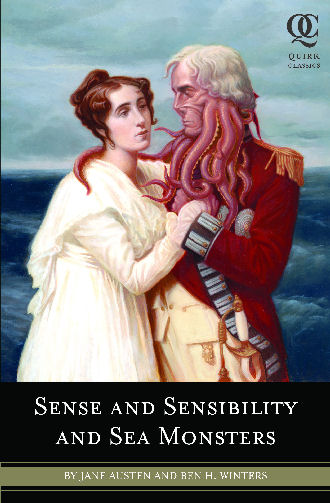
Book Review: Sense and Sensibility and Sea Monsters

Earlier this year I read Pride and Prejudice and Zombies, and as one would expect from the title, it was amazing. When people expressed puzzlement over what the book would be like, I responded with, "It's Pride and Prejudice. With zombies." And a big part of what made the book so enjoyable was reading familiar dialogue that had a whole different meaning. For instance, my favorite example of this is when Lady Catherine questions Elizabeth about her education, etc. In the original novel, Lady Catherine is of course asking about the standard education for young women of gentility. She expresses shock that five girls have been brought up without a governess. In P & P & Z, the "education" they discuss is their martial arts education (aimed of course at how to defend oneself against zombies). Lady Catherine expresses shock that they have no ninjas, if I recall correct.

I don't know, maybe it's just me, but the whole concept of the same, traditional dialogue having a new, zombie-related meaning, was my favorite thing about the book.

After reading P & P & Z, I anxiously awaited the release of Sense and Sensibility and Sea Monsters. Now, Sense and Sensibility is actually the only one of Austen's books that I have not actually read, but I own two separate film adaptations, and I love both of them.

But I didn't find S & S & SM to be nearly as enjoyable as P & P & Z. Mostly because the story had much more significant deviations from Austen's story than P & P & Z did. Apparently this was intentional. I read in an article by S & S & SM's author that the feedback on P & P & Z asked for less of Austen's original text. (As the article reports, 85% of P & P & Z was Austen's text.) So the publisher gave the author of S & S & SM permission to embellish significantly more. Blasphemy, I say.

Not that there aren't high points to S & S & SM. The scene where Lucy Steele tells Elinor about her engagement to Edward is pretty awesome. And there was one line by Mrs. Jennings that was utter delight, but all in all, I didn't find as much humor here as I did in P & P & Z. I think there may be another reason for that, however, apart from the dialogue/text. Pride and Prejudice is just full of characters ripe for parody; Sense and Sensibility, less so. Mrs. Jennings and Sir John were pretty much it as far as humor goes in S & S & SM. But in P & P & Z we had Mr. Collins, Lady Catherine, Lydia, Wickham, and Charlotte Lucas (hands down the funniest).

I'm curious to see what Quirk books will tackle next, however.

Tuesday, January 16, 2007

Book Update: Black Lamb and Grey Falcon

The book I'm currently reading, Rebecca West's Black Lamb and Grey Falcon: A Journey Through Yugoslavia is 1150 pages long, so forgive me if it takes me a while to finish it. Written in the late 1930's when the Nazis were starting to become pretty scary and before they invaded Yugoslavia, this book follows the author's trip through Croatia, Dalmatia, Bosnia and Herzogovnia, Serbia, Macedonia, and Montenegro. So far I've only read the the Croatian and Dalmatian sections, but I've taken note of some excepts that I really like so I thought I'd share them.

It's clear from her writing that West is (was) an extremely intelligent woman, and she is very gifted in her ability to see more than just the superficial in society and politics. When visiting Dalmatia, she is struck by the sight of a woman sitting on a wall as they passed by. I read somewhere that the odd shape of Croatia has a historical background in the Turkish invasion, and basically the borders lie where they do because the Turks were not successful in penetrating further into Europe. Specially West mentions how Venice, while it controlled regions of Dalmatia, would essentially collect monies from the natives to pay off the Turks in order to momentarily halt the western progress of the Ottoman Empire. When West came upon the woman in that poor region she wrote:

The west has done much that is ill, it is vulgar and superficial and economically sadist; but it has not known that death in life which was suffered by the Christian provinces under the Ottoman Empire. From this the people of Rab had saved me: I should say, are saving me. The woman who sat on the stone wall was in want because the gold which should have been handed down to her had bought my safety from the Turks. Impotent and embarrassed, I stood on the high mountain and looked down on the terraced island where my saviors, small and black as ants, ran here and there, attempting to repair their destiny.

I'm a bit of a history buff, so her combination of travel and history (that I imagine is very prevalent in modern travel writing) is really fascinating to read. But she can also be witty and sharp, as this excerpt from her visit to a girl's school shows. She writes to the girls:

Remember, when the nuns tell you to beware of the deceptions of men who make love to you, that the mind of man is on the whole less torturous when he is love-making than at any other time. It is when he speaks of governments and armies that he utters strange and dangerous nonsense to pleas the bats at the back of his soul. This is all to your disadvantage, for in love-making you might meet him with lies of equal force, but there are few repartees that the female governed can make to the male governors.

This book is full of insights such as that, and I am thoroughly enjoying the read!

Thursday, August 10, 2006

Book Review: Northanger Abbey

I really love Jane Austen. Everyone says that her work is "timeless" because it really is. The introduction to Northanger Abbey said that is believed that this book was written when Austen was young, and I would believe that because there was a certain immaturity to the work. I personally felt like there wasn't much of a plot in this book. The heroine, Catherine, goes to Bath with friends and meets two families, the Thorpes and the Tilneys. Her experience with the Thorpes supposedly shows her naivete and is a warning to girls about too much innocence. I guess I can believe that because the Thorpes were shallow and transparent, and Catherine's friendship was exploited but she never seemed to notice it.

Mr. Tilney is the hero of the book but I thought he was a rather boring character, myself. He himself wasn't boring as he was outgoing, liked to tease, and really could be a little too sarcastic at times. But there didn't seem to be any depth to him or to Catherine for that matter. I couldn't understand why he'd be attracted to a dolt like Catherine, but I suppose her frequent description of "good humoured" would be the reason why. It was hardly satisfying, however, at the end of the book when Austen commented that Mr. Tilney first became interested in Catherine because he found out that she had feelings for him. I have to admit that I've done the same in the past, but that's not something you want to read about in a romantic novel. She was quite simply flat.

Austen's writing pushes this book along. There is heavy narration, and at times I actually laughed out loud from her clever quips and comments. This is one of my favorites:

Mrs. Allen was one of that numerous class of females, whose society can raise no other emotion than surprise at there being any men in the world who could like them well enough to marry them.

We all know women like that!

Lindsey's Grade: B