Showing posts with label fiction. Show all posts

Wednesday, June 30, 2010

Book Review: Insatiable

I was so excited to read Meg Cabot's Insatiable when I heard that it was kind of a spoof on the current vampire craze in pop culture. Meg Cabot is one of my favorite humor writers; her Boy series is so funny. Maybe my expectations were too high, because I didn't really think that Insatiable was all that great.

Meena Harper is a dialogue writer for a soap opera called Insatiable. She also happens to have a supernatural ability to know how a person is going to die when she meets them. (Although what she sees can change if they change their course, which they often do based upon advice that she doles out.) Obviously this makes relationships of all types difficult.

Here's one more fact about Meena--she is sick and tired of the vampire craze. A rival soap opera, Lust, features a vampire plot that is killing in the ratings. So when the higher-ups tell Meena that they are going to incorporate vampires into their storyline, she's even extra pissed.

On the bright side, she meets a Romanian prince named Lucian, and she doesn't have any visions regarding his death! Amazing! Well, there's a reason for that; she can't see how he dies because he's already dead. He's a vampire. But Meena doesn't find this out until after she's slept with him. Oops. And she learns this tidbit from a Vatican-employed vampire hunter named Alaric.

To me, the storyline was pretty average. If she was spoofing the current vampire craze, I didn't really get it. She employed most of the same plot tricks that vampire writers use. Only at this point, it's all been done before.

Even worse, I didn't feel that the humor in this book was anywhere near the level that it was in The Boy Next Door, Boy Meets Girl, or Every Boy's Got One. I don't remember laughing out loud even once, something that is pretty rare for a Meg Cabot novel.

All in all, I'd say that this book is worth the read, because it is mostly lighthearted and fun, but I'd wait until it is out in paperback. Especially because there is a sequel, which of course made this book disappointingly lack closure.

Wednesday, April 28, 2010

Book Review: The Girl Who Played With Fire

Okay, Stieg Larsson fans, was anyone else pissed about the ending of this book?  I'm sorry, but if I'm going to spend my entire morning finishing a book instead of doing all the homework and writing all the papers I need to, then I expect to get some fucking closure.  (Pardon my French.) (Also, didn't you used to be able to wrap text around images on Blogger?  What am I doing wrong?  I cannot figure this out for the life of me.)
As far as the Millennium books go, I am torn on which one I like better.  I don't think I would necessarily say that The Girl Who Played with Fire is a better book, or even a more interesting book.  I much preferred the mystery of The Girl with the Dragon Tattoo.  But at the same time, I found this book more enjoyable to read.  

I gotta tell you, though, I'm a little worried for The Girl Who Kicked the Hornet's Nest or whatever the heck the third book is called.  If it ends as abruptly as this book, I am going to be pissed, because Larsson is dead, that's the last book he wrote, and I need my goddamn closure.


Thursday, April 15, 2010

Book Review: The Girl With The Dragon Tattoo

There is hardly a literary bandwagon I don't jump on at some point in time.  I may not have read Harry Potter until long after Deadly Deathly Hallows was published, but I got there eventually.  Same goes for Twilight.  So of course I had to jump on the current Millennium trilogy bandwagon, too.  

I used that book cover because that is what my copy of the book looked like.  I bought my copy in the Amsterdam airport because I'm just THAT cool.  Okay, not really.  If I were really cool, I would have known that I should have bought the last book in the trilogy because it was just sitting there on the table in the airport shop, available for purchase.  Because guess what?  The third book is not available in the United States yet.  Damn it!  I lost my chance.  

Oh well.  It's not such a bad thing because, to be honest, I'm not nuts about this series.  Don't get me wrong, I enjoyed The Girl with the Dragon Tattoo, and I didn't guess the ending (which is always nice in a mystery).  I'm even reading the second book right now, The Girl Who Played with Fire.  But I'm not really having any kind of emotional reaction or attachment to these books or to the characters.

I think part of the problem is the language barrier.  My favorite books tend to be ones written by American, British, or Australian authors, mostly because I like to read books in their original language, and I am embarrassingly monolingual.  Nevertheless, some books are beautifully, effortlessly translated.  Les Liaisons Dangereuse blew me away; I never would have guessed it wasn't originally an English-language book (other than the fact that that author is French, it is entirely set in France, and the characters are all French, of course).  But other times translated books come across as dry.  Sadly, I'm putting The Girl with the Dragon Tattoo in this category.  In my opinion, it read like a book translated into another language.

But aside from the translation, I think that I'm just not a big fan of the mystery genre.  I like characters and character-driven stories.  I think that mystery novels are, by their nature, more plot-driven.  Even though the two main characters of the Millennium trilogy, Mikel Blomkvist and Lisbeth Salander, certainly are three-dimensional and interesting, I just feel like thus far in the series it's been more about what they do than who they are.  Maybe that will improve as I continue with The Girl Who Played with Fire.  I'm slightly optimistic.

Also, did anyone else who read this book feel like it took more than half of the book to really get the story moving?  I felt that way. 

Saturday, February 20, 2010

Book Review: Testimony

Anita Shreve is one of my favorite authors, and I bought Testimony shortly after it was released, but I didn't get aroudn to reading it until now.

Each chapter of this book is written from the perspective of one of the multiple characters.  Most chapters are written in first person, some in third person, and there's even one written in second person.  Each character is giving their testimony of the events that surrounded a sex scandal at a private secondary academy in Vermont.

The problem with this book centers on the sex scandal. It starts when Mike, the principal, is given a videotape that was filmed in one of the dorm rooms.  In the video, a fourteen year-old female student performs oral sex on an eighteen year-old male student, then she has sex with another male student (who is either seventeen or eighteen), while a nineteen year-old males student watches and masterbates.  Everyone appears to be drunk.

Yes, it is statutory rape, and that is a crime, but I just had a really hard time accepting the magnitude of this scandal.  Shreve describes it as so big and receiving so much media attention that Anderson Cooper and Brian Williams types camp out at the school.  One characters recalls that the small town of one thousand doubled in population.

Come on.  Even if the scandal was compounded by the school's attempt to keep it quiet, I don't think a reader can reasonably be expected to believe in all this.  I went to a private boarding academy, and sexual stuff went on all the time.  There were even some crimes committed, and we didn't even get local news attention.

This was disappointing to me, because it really affected my ability to enjoy this book.  What I love about Shreve is how much she can convey with her simple style of writing.  Body Surfing is an excellent example of this.  Also, I just had a hard time connecting with her characters in Testimony.  I didn't feel the emotional connection like I did in Light on Snow, for instance.  This is not one of her best works, in my opinion.  If you've never read Shreve before I would recommend starting with Body Surfing, Light on Snow, Resistance, or Fortune's Rocks.

Monday, December 28, 2009

Book Review: The Tenant of Wildfell Hall

At last, I have finished Anne Bronte's The Tenant of Wildfell Hall.  Now I have read a book by each of the Bronte's sisters.  I'm sure there are many that will disagree with me, but I think that Anne Bronte is the lesser known sister for a reason.

The Tenant of Wildfell Hall begins with the narration of Gilbert Markham, a young farmer from a small English village.  When a young widow and her son move to the village, she and Gilbert clash a bit because she is very solitary and protective of her son.  But Gilbert is rather persistent, and eventually friendship and more develops between them.  But the widow, Helen, resists any romantic relationship and, amid rumors that she is her landlord's mistress, she tells Gilbert her story.

Helen married when she was very young to a handsome and charming man who soon proved to be a reprobate.  Much of the book is about her miserable married life to Arthur Huntingdon.  I did feel for Helen, and I think that given the time the book was written in, the subject matter of a disastous marriage was pretty scandalous.  But I didn't find it all that compelling of a story.

But the book did have its moments.  There is one character, Walter Hargrave, who I found to be one of the most dispicable characters I've read about in a long time.  He is a friend of Helen's husband, Huntingdon, but he repeatedly tries to win Helen's heart.  He makes sure to take every opportunity to point out every bad thing that Huntingdon does wrong, how awful he is, as if that will induce Helen to throw aside her own morals.  I'm not describing this very well, but he's gross.  So gross.  Helen rejects him at every turn, but he won't leave her alone, no matter how clear she makes it that she wants nothing to do with him other than a polite friendship. 

Hargrave's behavior is part of the reason why I didn't really like Gilbert, because he kind of does the same thing.  He continues to pursue Helen even after she makes it clear she's not interested in a relationship.  And even after he finds out that she's still married, he uses Hargrave's logic that Huntingdon's adultry releases her from her duty of fidelity.  I couldn't understand why Helen responded to Gilbert's attention, but I suppose he does have redeeming qualities.  He's a good man (even though he is at times prone to jealous rage!) and he doesn't drink and whore around like Huntingdon and his friends did. 

But Gilbert and Helen were both a little bland.  I think that is one reason why the novels by Anne's sisters are more famous.  There's just more going on with the characters and with the plots that makes them interesting and memorable.  I mean, I'm glad that Helen gets to have her happy, pious life eventually, but it's boring. 

Sunday, November 22, 2009

Book Review: Rebecca

I

I have mixed feelings about Rebecca.  It was certainly entertaining, but there were so many frustrating things about it, too.  But then, I'm pretty sure that I was supposed to find those things frustrating.  I guess I can sum it up by saying that du Maurier certainly knows how to evoke certain emotions from her readers.

For those who are not familiar with Rebecca, it is the story of the second Mrs. de Winter.  (The reader never knows her first name.)  She is young, shy, and gauche when she marries Maxim de Winter, a man old enough to be her father, after a whirlwind "romance" in Monte Carlo where they met on vacation.

Things are going well until the newlyweds return to Manderley, Maxim's family home in Cornwall, England.  Maxim's first wife, Rebecca, drowned in a boating accident ten months prior to the second marriage, and the staff there are constantly telling the new wife "Mrs. de Winter did it this way," "Mrs. de Winter did it that way," etc.  It's pretty rude that these servants keep reminding the new wife that she is taking someone else's place.  The housekeeper, Mrs. Danvers, is particularly bad, and she takes an immediate dislike to the new wife.

You want to just scream at the new wife to grow a spine and put these rude servants in their place, but she doesn't do it.  It is understandable why she doesn't—she's practically fresh out of the schoolroom, and she has no experience managing a household, etc.  She needs to rely on the servants to tell her how to get stuff done, but all they can do is bring up her husband's dead wife.  And it's not just the servants.  Maxim's sister, his grandmother, and others are constantly bringing up Rebecca.

To make matters worse, Rebecca was everything the new wife is not.  Beautiful, witty, outgoing, etc.  So it's not surprising that the new wife develops a crippling complex.  She worries constantly that people will gossip about her and her marriage.  And she eventually becomes convinced that Maxim will never love her the way he loved Rebecca.

My annoyance with the new wife was hard to overcome at times, but I think that is an integral part of the story.  You really, really want her to stand up for herself, and even she wants to stand up for herself, but she's so terrified of making a false move that she just plays it safe.  I thought it was a very realistic portrayal, as unappealing as it was.

There is an air of mystery to the book, too, but I can't really discuss it without giving too much away.  So warning: SPOILERS AFTER THE JUMP!  (For those of you who are not going to continue reading, just trust me that the story is a very fun read.)

Status Update

Oh my God, ya'll. This book Rebecca just got CRAZY! Crazy good!

Tuesday, November 17, 2009

Book Review: Jane Eyre

Hooray! I finished Jane Eyre about a decade after I first tried to read it! I don't know about you, but I always feel such smug satisfaction after reading a work of classic literature. I can feel my snobbery increase.

And alas, I must confess that I actually enjoyed Jane Eyre quite a bit. Ten years ago I found the title character to be boring, but I think I quit reading too early. She didn't really win my respect until after Rochester proposes. There were certainly signs of her feisty independence prior to that point, but I was unconvinced. Then she really turned it on:

Do you think, because I am poor, obscure, plain, and little, I am soulless and heartless? You think wrong! I have as much soul as you, and full as much heart! And if God had gifted me with some beauty, and much wealth, I should have made it as hard for you to leave me, as it is now for me to leave you.

Poor Jane! You give it to that big, rich oaf you're sure is cruelly teasing you! And what do you know, little Jane Eyre turned out to be quite the budding feminist:

"Oh comply!” [the inner voice] said. “Think of his misery, think of his danger, look at his state when left alone; remember his headlong nature, consider the recklessness following on despair; soothe him, save him, love him; tell him you love him and will be his. Who in the world cares for you? or who will be injured by what you do?

Still indomitable was the reply. “
I care for myself.

Love it. You've got to love Jane, if for no other reason, because she really knows how to stick to her guns. She is not immune to emotion and temptation, but she is a strong enough woman to make her own choices.

After reading Jane Eyre, I feel I am now well-versed in the great romantic literary heroes from the first half of the nineteenth century: Darcy, Heathcliff, and Rochester. (Was Pride and Prejudice written before 1800? Well, let's pretend here that it wasn't.) It seems like I read somewhere that Rochester was voted the most romantic literary hero. I guess I can see that. He's more passionate than Darcy, but less crazy than Heathcliff. Not a bad combo.

Like Jane, Rochester also had to grow on me as the novel progressed. It was very well done of Bronte, I must say. I loved this little description that really seemed up sum up Rochester's feelings towards Jane:

Mr. Rochester had sometimes read my unspoken thoughts with an acumen to me incomprehensible; in the present instance he took no notice of my abrupt vocal response, but smiled at me with a certain smile he had of his own, and which he used but on rare occasions. He seemed to think it too good for common purposes; it was the real sunshine of feeling—he shed it over me now.

It's so romantic! He gives her his special smile! Sure, Rochester has some MAY-JA flaws, but as with Heathcliff, I'm willing to forgive them because I know his history. And poor Rochester! Married to a crazy lady for four years before he finally decides that he deserves to have a life of his own. But he can't escape her, and Thornfield becomes tainted with her presence:

The glamour of inexperience is over your eyes,” he answered; “and you see it through a charmed medium; you cannot discern that the gilding is slime and the silk draperies cobwebs; that the marble is sordid slate, and the polished woods mere refuse chips and scaly bark.

It is so tempting to hate Rochester for what he does to both Bertha and Jane. But I found that I couldn't hate him. In fact, the way he treats his mad wife is actually kind of endearing (once you remind yourself that mental health professionals at that time probably couldn't have done anything more for Bertha):

I could have lodged her safety enough, had not a scruple about the unhealthiness of the situation, in the heart of a wood, made my conscience recoil from the arrangement. Probable those damp walls would soon have eased me of her charge; but to each villain his own vice; and mine is not a tendency to indirect assassination, even of what I most hate.

My favorite passage in the book occurs after Jane and Rochester's wedding is thwarted, when he confesses to her in private. He pours out his heart to her describing the misery he's lived with and the hope that Jane brought into his life. It's so well done that you can easily forgive him for wanting to marry Jane despite the fact that his wife was still alive. He loves Jane so much!

Contrast that with the proposal Jane gets from St. John Rivers. Charlotte Bronte, I bow down to you. If the reader was unconvinced about Rochester's love for Jane, then this sealed the deal. When St. John bumbles his proposal so massively, you start to see how accurately Rochester saw Jane. Unlike St. John, Rochester looked past the exterior to the real person within, and that is who he loved. I was indisputably on Team Rochester at that point. When he said the following to Jane, telling her that he would continue to love her even if she went mad like Bertha, I audibly sighed:

Your mind is my treasure, and if it were broken it would be my treasure still . . . . In your quiet moments you should have no watcher and no nurse but me; and I could hang over you with untiring tenderness, though you gave me no smile in return; and never weary of gazing into your eyes, thought they no longer had a ray of recognition for me.

Is that not the sweetest thing ever? And how ironic that Rochester is so willing to be Jane's nurse, but after he is blinded and maimed he doubts that she would want him in his state.

As far as the writing goes, I think Jane Eyre beats Wuthering Heights and Pride and Prejudice. It is so beautiful and vivid. But as far as the love story goes, I say it comes in third. I don't know; I really enjoyed this book, but I didn't fall in love with it.

BTW, I added the film version to Netflix queue, the one starring the actors in the picture I chose. Is it just me, or are both of them a wee too attractive to be Jane and Rochester? I mean, considering that the book hits us over the head again and again with the fact that they're both ugly? I don't care, I still want to see it. I'll just tell myself that what was ugly back then is seksi now. Kind of like when people used to tell me that I would have been the epitome of beauty two hundred years ago because I'm plump and pale. Gee thanks, that really helps me now in the twenty-first century.

(I really have to get this shirt now.)

Monday, November 02, 2009

Book Review: Supreme Courtship

I picked this book up from a display at Barnes and Noble and after reading the summary on the back cover, I was hooked.

This is really all you need to know to grasp how fun the plot of this book is:

The President of the United States has dismal approval ratings. He vetoes every spending bill that comes across his desk. Congress has drafted a constitutional amendment limiting presidents to a single term; they hate him that much (even though he's a good guy). When a Supreme Court justice goes bonkers and is forced to retire, the President nominates two eminently qualified judges.

Both are destroyed by the Senate Judiciary Committee, which is chaired by a Senator who wanted (and even asked for!) the nomination himself.

Fed up, the President says "what the hell" and nominates Pepper Cartwright, TV judge along the lines of Judge Judy, to the United States Supreme Court.

I know, right? 'Nuf said. I bought it.

But it gets even better. The Chief Justice of the Supreme Court cast the deciding vote in a case that legalized gay marriage across the United States. A few days later, his wife left him for another woman.

Now you know where the "courtship" in Supreme Courtship comes in.

This was a fun and funny book that I read in less than a day. It's a not-so-subtle satire, which was nice because it meant that I got the satire (unlike in On Beauty). I recommend!

Lindsey's Grade: A-

Tuesday, October 27, 2009

Book Review: Les Liaisons Dangereuses

If you've seen the movie "Dangerous Liaisons" or "Cruel Intentions," then you have a pretty good grasp of what Les Liaisons Dangereuses is about. But I would still recommend reading the book because it's awesome.

Don't you love how my book reviews read like 6th 3rd grade book reports? I thought so.

Okay, I will say more. Les Liaisons Dangereuses is set in France during the 1780's (pre-Revolution). The format of the book is 175 letters written between the various characters. The two principle characters are the Vicomte (Viscount) de Valmont and the Marquise (Marchioness) de Merteuil. The book revolves around them and their relationship. Valmont is generally known as a rouge, a rake, a man who seduces women for sport. The Marquise, however, is a wealthy aristocratic widow who has maintained an air of social respectability. But she is the really the one to watch out for.

Valmont and M. de Merteuil meet when their respective lovers cast them aside in order to "hook up," for lack of a better term. The two of them form their own attachment (and by "attachment" I mean sexual dalliance) after the experience, and remain friends after they part ways. M. de Merteuil, however, holds quite a grudge against the man who cast her aside, the Comte (Count) de Gercourt. When the opportunity to get back at him presents itself, she takes advantage of it.

A distant relative of hers, the Madame de Volanges, has a fifteen year-old daughter fresh out of the convent, named Cecile, and she has arranged a marriage between her daughter and Gercourt. M. de Merteuil is outraged and insulted when she discovers this, in part because it adds insult to injury that she should in any way to related to Gercourt. So she hatches a plan to cuckhold Gercourt by ensuring that his innocent bride-to-be is not-so-innocent when she marries him. For this, she needs the assistance of her friend and legendary seducer-of-women, Valmont.

But Valmont has a scheme of his own. He is visiting his aunt's country home when he meets the Presidente de Tourvel, a beautiful and virtuous woman who is renowned for her faith, piety, and fidelity. What better challenge could there be, what greater claim to greatness could he acquire, than if he were to seduce the Presidente and gain her submission? He turns down M. de Merteuil's offer to seduce Cecile Volanges in order to focus on the Presidente. But M. de Merteuil does not give up, she just uses other means to accomplish her goal. Particularly she looks to a young chevalier (knight), Danceny, who shares a mutual affection with Cecile.

But when Valmont's efforts are hindered after Madame de Volanges tells the Presidente about his reputation, he decides to take his revenge upon Madame de Volanges by taking on the seduction of both the Presidente and Cecile.

Valmont and the M. de Merteuil are absolutely ruthless. They lie effortlessly in letters to their victims, then gleefully relate their successes in letters to each other. I love the letter format of this book because it beautifully demonstrates their duplicity and utter lack of shame. And although Valmont is the character who does most of the work in this book—he is the one doing the on-the-ground seduction—this book belongs to the M. de Merteuil. She's a fascinating character, and I think Laclos is an absolute genius for creating her and knowing exactly how she would act and react in certain situations. My favorite line of hers comes when she is describing her latest boy toy and how he wants their relationship to be exclusive: "He must rate me lightly indeed, if he believes he has worth enough to make me constant!" God, is that the story of my life or what?

Valmont's character development is certainly a crucial plot point of this book (and if I recall, it seemed to dominate the movie Cruel Intentions, too) as he begins to fall for the Presidente. But the M. de Merteuil is always one step ahead of him. She sees where he is heading long before he does. She knows just what buttons to push, exactly what to say in order to get Valmont to do what she wants him to do. She's not immune herself, however. The events she and Valmont have put into motion also drag her along a path she never intended to go down. But she was never manipulated. Unlike the other female characters in the book, she falls victim only to herself and her own weaknesses. Despite how evil she is, I love her for that. I respect her for it. She is a one-of-a-kind woman, and she knows it:

Oh! keep your advice and your fear for those delirious women who call themselves sentimental; whose exalted imagination would make one believe that nature has placed their senses in their heads; who, having never reflected, persist in confounding love with the lover; who, in their mad illusion, believe that he with whom they have pursued pleasure is its sole depository; and truly superstitious, show the priest the respect and faith which is only due to the divinity. Be still more afraid for those who, their vanity being larger than their prudence, do not know, at need, how to consent to being abandoned. Tremble, above all, for those women, active in their indolence, whom you call women of sensibility, and over whom love takes hold so easily and with such power; who feel the need of being occupied with it, even when they are not enjoying it; and, giving themselves up unreservedly to the fermentation of their ideas, bring forth from them those letters so sweet, but so dangerous to write, and are not afraid to confide these proofs of their weakness to the object which causes it: imprudent ones, who do not know how to discern in their present lover their enemy to be.

But what have I in common with these unreflecting women?


Above all else, Laclos's story is exquisitely crafted. And the translation I read by Ernest Dowson was also great; everything flowed wonderfully, and each character had their own tone that remained consistent throughout the book. There are parts of this book that made me laugh out loud and parts that made me gasp in disbelief at just how debase Valmont and the M. de Merteuil could be. As far as classics go, it is one of the most entertaining books I've read. If it weren't for the sexy sexy sex all throughout the book, I would have wondered why this isn't more standard school reading. Loved it.

Lindsey's Grade: A+

Sunday, September 27, 2009

Book Review: On Beauty

Anyone who even tangentially follows book news will remember that when Zadie Smith's On Beauty came out a few years ago, it was basically hailed as a masterpiece. It made all sorts of "Best of" lists, and I think it won some awards, too. So when I was looking for a book to read at Charles de Gaulle airport this summer, before a long flight home to the States, I picked this one up. (Also, I had a few euros I needed to get rid of.) I anticipated a reading experience that would knock my socks off.

Not so much.

I truly, honestly think that I am not intellectual enough to "get" this book. The reviews on the cover and all that talk about how funny and hilarious it is. Uh, not funny. Not hilarious. Apparently it's a satire. Of what, I'm still not sure, but I think maybe intellectuals and intellectualism. I am not an intellectual. I will admit that without hesitation. So I think that's why I wasn't able to pick up on the satire.

Zadie Smith, however, is an incredible writer. There's nothing I hate more than reading a book where the author's efforts are so obvious. Good writing is effortless, and Smith's writing is effortless. Unfortunately, I just didn't care about the people she was writing about. The book centers around a family in Massachusetts—the Belseys. The father, Howard, is an art professor at a small college in the town where they live. The mother, Kiki, is a nurse/health administrator. Their three children are Jerome, Zora, and Levi. Everyone has their own story in this book, and most of them are interconnected. I liked Kiki and the kids, but Howard... gross. No. Didn't like him at all. I think he was being satirized, but like I said, if you don't know what is being satirized, it's not funny. (Like that whole New Yorker cover of Michelle Obama during the campaign.)

I read a lot of reviews of this book on Amazon.com, and a lot of people seemed to agree with me that this book was not all that and a bag of chips, as the industry reviews would have led us to believe. So it's nice to know that I'm not the only one who found this to be a rather forgettable book. I guess that in the end I'm not sorry I read it, though. Maybe someday I can have a pseudo-intellectual conversation with someone about how I'm not intellectual enough to enjoy it.

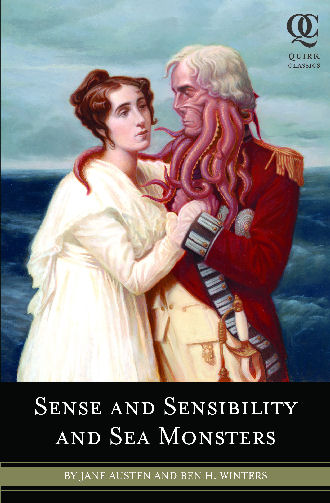
Book Review: Sense and Sensibility and Sea Monsters

Earlier this year I read Pride and Prejudice and Zombies, and as one would expect from the title, it was amazing. When people expressed puzzlement over what the book would be like, I responded with, "It's Pride and Prejudice. With zombies." And a big part of what made the book so enjoyable was reading familiar dialogue that had a whole different meaning. For instance, my favorite example of this is when Lady Catherine questions Elizabeth about her education, etc. In the original novel, Lady Catherine is of course asking about the standard education for young women of gentility. She expresses shock that five girls have been brought up without a governess. In P & P & Z, the "education" they discuss is their martial arts education (aimed of course at how to defend oneself against zombies). Lady Catherine expresses shock that they have no ninjas, if I recall correct.

I don't know, maybe it's just me, but the whole concept of the same, traditional dialogue having a new, zombie-related meaning, was my favorite thing about the book.

After reading P & P & Z, I anxiously awaited the release of Sense and Sensibility and Sea Monsters. Now, Sense and Sensibility is actually the only one of Austen's books that I have not actually read, but I own two separate film adaptations, and I love both of them.

But I didn't find S & S & SM to be nearly as enjoyable as P & P & Z. Mostly because the story had much more significant deviations from Austen's story than P & P & Z did. Apparently this was intentional. I read in an article by S & S & SM's author that the feedback on P & P & Z asked for less of Austen's original text. (As the article reports, 85% of P & P & Z was Austen's text.) So the publisher gave the author of S & S & SM permission to embellish significantly more. Blasphemy, I say.

Not that there aren't high points to S & S & SM. The scene where Lucy Steele tells Elinor about her engagement to Edward is pretty awesome. And there was one line by Mrs. Jennings that was utter delight, but all in all, I didn't find as much humor here as I did in P & P & Z. I think there may be another reason for that, however, apart from the dialogue/text. Pride and Prejudice is just full of characters ripe for parody; Sense and Sensibility, less so. Mrs. Jennings and Sir John were pretty much it as far as humor goes in S & S & SM. But in P & P & Z we had Mr. Collins, Lady Catherine, Lydia, Wickham, and Charlotte Lucas (hands down the funniest).

I'm curious to see what Quirk books will tackle next, however.

Thursday, September 03, 2009

Book Review: Birdsong

It seems to me that the majority of war movies and war novels that I've encountered have dealt with World War II. I don't know why that is exactly, but I suspect it has to do with a few things: (1) It is seen as the "noble" war because of Hilter and the Nazis; (2) There are so many high-profile things to come out of WWII such as the Holocaust, Pearl Harbor, and Hiroshima/Nagasaki; and (3) Many people have known people who are still alive that fought in the war.

World War I, on the other hand, doesn't seem to get much attention. That is one thing I liked about Birdsong by Sebastian Faulks—it pays the proper homage to the men that fought in the trenches. This book is pretty intense. When Faulks takes his characters through the Battle of Somme in July of 1916, I had to stop reading and take a break. It was just too much for me. Normally I don't have a problem watching or reading about horrible things, but somehow this was different. I think that when you read a work of fiction that deals with a homicidal psychopath, or even hear about something like that on the news, it is not so difficult to take in because, although you know these things happen to actual people, you can assure yourself that it's rare and isolated.

You can't do that when you read about the lives of the soldiers in Birdsong because these experiences were not rare and isolated. A generation of men lived through this hell, and it was hell.

Once more in ragged suicidal lines they trudged toward the pattering death of mounted guns. Bloodied beyond caring, Stephen watched the packets of lives with their memories and loves go spinning and vomiting into the ground. Death had no meaning, but still the numbers of them went on and on and in that new infinity there was still horror.

It feels real because it is real. Great Britain just lost its last WWI veteran about a month ago, and the knowledge that a man who had experienced all of this lived on this earth with me is pretty powerful. I didn't much care for Part I of this book, which involved the pre-war experiences of the main character, Stephen Wraysford, because I felt that it was a pretty run-of-the-mill romance. But I suppose it's necessary to set you up for Stephen's experiences during the war. There are also a few portions set in 1978 with Stephen's granddaughter that I could have done without, but they also just serve to amplify the other portions of the book.

As far as war novels go, this is one of the best I've ever read. This was supposed to be "The War to End All Wars," and I can certainly understand why. How anyone who lived through that could ever want to enter into another war twenty years later is beyond me.

Wednesday, September 02, 2009

Summer Book Clubs

I joined two books clubs this summer, and between the two clubs I read four books. (I did not read a fifth book club book due to a longer-than-expected recovery from wisdom teeth extraction surgery. Ouch!) But anyway, here they are.

I don't even know where to start with this book. It is (inexplicably) set in 1991, and it centers around Connie, a doctoral candidate in history at Harvard University. Connie has just been granted candidacy and has to start thinking about thesis subjects when her mother asks her to look after an old house about an hour from Cambridge that belonged to Connie's grandmother. While Connie is exploring the old house, she finds a piece of paper with the words "Deliverance Dane" on them. Because she's curious and seems to want to avoid her thesis work, Connie starts investigating and discovers Deliverance Dane was a witch (at least ruled to be one) that bequeathed a book to her daughter, who then passed it on, etc, etc. Connie searches for this book for the rest of the novel.

Don't waste your time reading this book. I personally don't think it ever goes anywhere interesting. The ending is predictable, and Connie is a fucking idiot. We're supposed to believe she's this brilliant scholar, but the damn woman doesn't even realize what her own name is. Seriously. I'm not making that up. I figured out what her name actually was and what significance it held before she did. Lame. Katherine Howe seems to think that her readers are retarded and will put up with Connie being so dumb.

But what I disliked most about The Physick Book of Deliverance Dane was that is so obviously full of smug. Howe is clearly a New Englander who did graduate work at Harvard, because, from the way she writes this book, she seems to think that Connie's life is pretty normal. Not only that, she is always throwing in little comments about grad school, Harvard, New England, etc, to prove to the reader that she's an insider or something. It's so annoying, because I really felt like the privilege of her life was completely lost on Howe. I know people say to write about what you know, but most of the world doesn't give a shit about some lame-ass grad student from 1991 who wears a lot of turtlenecks and spends her summer doing NOTHING worthwhile. Meanwhile, people are losing their homes and children are going hungry.

Don't read Sarah's Key if you don't want to shoot yourself in the head afterwards. Okay, that's unfair. But this book is super depressing.

It is mostly set in modern Paris. The main character Julia is an American who is married to a Frenchman and has lived in Paris for years. She works as a journalist, and one day she is assigned to write about the anniversary of an event in Paris history when the French government collaborated with the Nazi occupiers to detain and deport Parisian Jews. From one of the first deportations, most people went to Auschwitz and a staggering percentage of them died.

I forget how Julia makes the connection, but she eventually links the apartment she and her husband have inherited from his grandmother to a Jewish family that lived there before being taken away, particularly their young daughter. The incredibly sad story revolves around this girl.

I did like this book, but at the same time I didn't. I liked it because it alerted me to a part of French history that I really didn't know about. The author's characterizations of the French people in the book and the way they reacted to it was very interesting, and I got the impression it was something she'd experienced firsthand. A lot of French people do not like to talk about these events because it is a very shameful part of their history. This was not Nazi's knocking on doors, rounding people up, and busing them to their deaths—this was French police and French people. But on the other hand, Julia's reaction to events 60 years in the past that she had nothing to do with struck me as very manufactured. You'd have to read the book to know what I mean, but it just seemed unnatural to me how emotionally involved Julia got.

Fun tidbit: I got a little worked up at the book club discussion of this book after a woman in the group shared her thought that "religion is to blame for all bad things," or something along those lines. I'm all for laying blame at religion's feet when it's due, but I hardly think that the Holocaust can be laid at the feet of religion.

Here's what I will say about Run: it was a good story, but I didn't really take away any deeper message. The story revolves around an incident in Boston during the winter. Tip and Teddy are black, biological brothers who were adopted by a white couple. When they were very small, their adopted mother died of cancer, and they were raised by their father, Doyle, who eventually becomes mayor of Boston. They have an older brother, Sullivan, who is their parent's biological child.

When they're older, Sullivan is the black sheep who lived through a scandal that damaged his father's career. Doyle has poured all of his energy into Tip and Teddy with aspirations of them going into politics, but neither is interested. Tip just wants to study ichthyology (his major in college), and Teddy is interested in the priesthood (their mother's uncle is a Catholic priest). The three of them (Doyle, Tip, and Teddy) go to a Jesse Jackson lecture Doyle forced them to go to, and as they're leaving a car nearly hits Tip as he's not paying attention. He is saved when a woman knocks him out of the way, only to be hit herself. Her ten year-old daughter Kenya witnesses it. It's not really a spoiler if I tell you that the woman is Tip and Teddy's biological mother, and she's severely injured.

The rest of the book is basically about the aftermath of the accident, and Kenya. Like I said, I really enjoyed the story, but I was not really moved by it, in the sense that I'll remember this book for years to come. Not a bad read, though.

A Thousand Splendid Suns, however, is great. A very, very good book. It is centered around two woman from Afghanistan, and their stories are so sad. It is a great way to get a better grasp on what life is like for Afghani women, even though this book spans a couple decades.

Wednesday, August 06, 2008

Book Review: Breaking Dawn

In case anyone cares, I'm going to throw out my two cents on the last installment of the Twilight series by Stephenie Meyer. SPOILER ALERT!


I really liked it. I know a lot of people didn't, and I know a lot of people have problems with the entire series. (For instance, Edward is too controlling and possessive.) That would probably bother me if these weren't books about teenage vampires. But since they are, I don't take it all too seriously. Not only is this fiction, it is fiction that could never, ever happen. I will even admit that at first I was a little bothered by the fact that Bella was so willing and eager to give up her life for Edward, but again I decided that I shouldn't take it too seriously. But I honestly feel like Breaking Dawn resolved some of the uneasiness I felt about the whole series.

For instance, I was never crazy about Bella becoming a vampire, even though the romance-novel-reader in me wanted them to be together forever. So when Bella's turning became a necessity instead of just a wish, I felt a lot better about it. Well played, Stephenie.

Also, I never liked Jacob's relationship with Bella because it made me uncomfortable that he was so obsessed with her when she wanted to be with Edward. So the whole imprinting on Bella's daughter was actually a clever solution to the problem, I thought. Yes, yes, some people think that's creepy. To them I say this: we're talking about a werewolf "imprinting" on a half-vampire child. Don't you think we can suspend reality enough in such a situation to believe that there is nothing gross in the relationship? I mean, if you're going to accept that he's a werewolf and she's a half-vampire, it's not too much more of a stretch to accept that their relationship is not within traditional human understanding, is it not? I thought the whole thing was an excellent solution to the problem I'd always had. Again, well played.

Some reviewers are saying Meyer just appeased everyone, but who the hell cares? These are books for teens, really. I really, really thought for a good while there that she was going to kill them all off and have them have a happily ever after in vampire heaven. Because that was kind of a question that lingered through the series--do vampires have an after-afterlife? And at one point in Breaking Dawn Meyer had Bella thinking that if there was an afterlife she could spend with Edward then that would be her "happily-ever-after." Considering that I had already seen that the title of the last chapter was "Happily-ever-after" I was sure everyone was going to die. So I was pleased that everyone didn't die. IT'S OKAY FOR BOOKS TO END HAPPILY, ISN'T IT?

My only complaint is in the biology (how can Edward get a stiffy IF HE HAS NO CARDIOVASCULAR SYSTEM?), but I can easily get over that. Suspend belief.

I think that people who have serious problems with this book and the whole series need to lighten up. They're inherently silly books, really. I read them for pure entertainment value and I'm glad that the entertainment aspect of them was preserved in the finale.

Well played, Stephenie Meyer. Well played.

Lindsey's Grade: A-

Monday, April 07, 2008

Book Reviews: Twilight, New Moon, Eclipse

I never in a million years would have thought that I would write a raving review about teenage vampire books, but here I am. Perhaps you have heard of these books: Twilight, New Moon, and Eclipse. Apparently they are bestsellers. The last book in the series is Breaking Dawn and it comes out in August. I CAN'T WAIT!

I think that part of the reason I enjoy these books so much is because they are set in Forks, Washington, which is on the Olympic Peninsula for those of you that don't know. A lot of scenes also take place in La Push, and I've been to both places. I love, love, love western Washington so reading about these places that I know and like is pretty cool.

The main character in Twilight is a seventeen year old girl names Isabella (Bella) Swan. Bella has lived her whole life with her mother in Phoenix, but when her mom gets remarried to a professional baseball player who travels a lot, Bella moves to Forks to live with her father, Charlie. In Forks she meets Edward Cullen, an incredibly handsome seventeen year old who is the member of a mysterious family in town, the Cullens. It doesn't take long before Bella discovers that Edward and his family are, in fact, vampires!

But the Cullens are unique vampires. Their patriarch, Carlisle, "created' all of them and taught them to live a "vegetarian" lifestyle, which essentially means that they don't drink human blood, only animal blood. They still crave human blood, and as it turns out, Edward happens to crave Bella's blood even more than the average person. Which makes the fact that they fall in love with each other pretty interesting...

But there are other bad vampires out there in the world and when three of them wander into Forks and find Bella hanging out with the Cullens, they're intrigued. And one of them wants Bella. How far will the Edward and his family go to protect Bella, and will it be enough? Ooooohhhh....

New Moon picks up a few months after where Twilight leaves off. This is actually my favorite of the three books that are out so far. Without giving too much away, I will say that there are some really interesting plot twists that occur in this book and that set up the rest of the series. Specifically worth mentioning is Jacob Black, a family friend of Bella's who is a sixteen year old member of the Quileute Indian Tribe in La Push. Tribal legend has told of members who turn into werewolves when vampires are around the community, as well of an ancient treaty between the tribe and the "vegetarian" vampires (i.e., the Cullens). Well, turns out the legends are true! And young Jacob turns into a werewolf, the mortal enemy of the vampires. How is Bella supposed to handle the feud between her true love, Edward, and her best friend, Jacob? Ooooohhhh.... (Tons of other important stuff happens, but I don't to give it away.)

Now we get to Eclipse, the most recently published book. This book is hard to describe without giving too much away about New Moon. There are things about Eclipse that makes me not like it as much as the other two books, but at the same time Meyer does some stuff here that is pretty intriguing. I didn't like what she did, but you know, sometimes your characters have a life of their own and a writer can't really control it. Maybe Meyer planned it all out, but there's a part of me that thinks that a natural progression occurred beyond her control. Let's just say that things get pretty complicated for Bella here. Vampires, werewolves, true love... that's a lot for an eighteen year old to handle.

I can't say why I like these books so much. It's not the vampires because I'm still pretty ambivalent about vampires, but Meyer is just a good storyteller. I care about these characters and feel like I'm a part of their lives. And she's set things up so that there is a really compelling story going on here (partly because Edward is going to be seventeen forever and Bella is... not. Can you tell where this is going?) I don't know how she is going to wrap all of this up in Breaking Dawn but I already feel like she can go a number of different ways and still have it be satisfying.

My one little gripe about these books has to do with the romantic relationship between Bella and Edward, and especially the developments in New Moon. I understand that they love each other and all that, but look, I've been seventeen and in love, too. I too was convinced that it was going to be forever, but as it turns out, it wasn't. There's a part of me that is concerned about the message that these books send about teenage relationships, but I'm trying to ignore that because, well, one of the teenagers is a vampire that was born in 1901, so he's been around the block. Maybe it's possible to fall eternally in love when you're seventeen if the person you fall in love with is a vampire, because really, that's a pretty special circumstance. And heck, I'd be in love with Edward Cullen, too.

I am really getting into Young Adult books, now, I don't know why. I kind of think that I have a Peter Pan complex, though. Young Adult books, High School Musical movies and music, teeny-bopper films, The Disney Channel shows... What's wrong with me?

Wednesday, March 05, 2008

Tess of the d'Urbervilles by Thomas Hardy

Tess of the d'Urbervilles by Thomas Hardy (1891)

First, check out the painting that was on the cover of my book. It alone caused me to want to read this book. She looks so sad. The painting, by Francis Danby, is called "Disappointed Love". I find it haunting.

I will admit that I am a thief. I have had a high school copy of this book since 9th grade Honors English. I can remember glancing at the book thinking it looks too hard to read. It's not. In fact I loved it. I'm actually surprised since I usually don't enjoy fiction, let alone classical fiction. Tess is hands down the most depressing character I have ever met in a book. Nothing goes well for Tess. She was deceived by a man at an early age and works so hard to bring herself out of poverty and despair, but soon finds herself back in it. I hated Angel Care, Tess's husband. I hated that he could have premarital sex and yet not forgive Tess for being raped as a teenager. Stupid men. I also despised him when he asked another woman to run away with him after not being able to forgive Tess. This was while still being married to Tess. Even though he doesn't go through with it he still is scum in my mind. Her rapist, Alec, also is a piece of work. A lot happens in this book and I don't want to ruin the ending for future readers **AHEM, LINDSEY AHEM**.
This is not a happy novel. It is the kind of book which makes you reflect upon humanity and a woman's role in society. It also reminds one to be grateful for what they have.

Kim's Grade: A

Sunday, January 06, 2008

Book Review: The Abstinence Teacher

The premise of this book seemed interesting enough for me to put it on my wish list for Christmas. A high school sex-ed teacher gets in trouble when she tells one of her students that "some people enjoy it" ("it" being oral sex). The girl's parents are members of a local evangelical church and they take offense, threatening a lawsuit. (Although I couldn't figure out what they would be suing over, myself.) So the school caves and changes its sex-ed curriculum to an abstinence-based program.

The teacher, Ruth, is a divorced mother of two, and her youngest daughter just happens to have a new soccer coach who is a member of the church. The two of them get into an argument on the soccer field one day when Tim, the coach, leads a prayer with all of the girls on the team.

I can see where the author was going with this book by pitting these two opposites against each other, and I think he did a very good job. It was particular interesting to me because Ruth was fairly conservative in her own life, while Tim was an ex-drug addict and musician who lived the "good life" for most of his adult life. Both characters were developed pretty thoroughly, although at times I felt like the people in Tim's life were pretty cliched at times. Tim and his wife Carrie were perhaps the exception to that.

I was pretty bothered by the religious tone in the book, mainly because the religious characters came across as rather crazy—especially Pastor Dennis, the church leader. But I think that was kind of the point. I found myself getting pretty upset over the things that were happening, and I was glad to see that Tim eventually started to open his eyes to the obsessive control that Pastor Dennis seemed to want to have over his life. I have to say, however, that it took a while for me to see all of the church-based stuff as something more than hyperbole, because I grew up in an inclusive Christian environment that has it's problems but was nothing like that. In the end the way that this book made me evaluate my own upbringing and how the Adventist church differs from these Evangelical churches was one of the best things about reading the book.

It wasn't hard to tell how the author felt about what he was writing about, but I did appreciate that way that he didn't make a villain out of Tim. In fact, he did a really good job of showing his humanness and how even Christians struggle sometimes. Unfortunately for Tim he didn't seem to realize that himself, and his pastor didn't do a very good job of helping him see that, either. I would say that an overarching theme I took from this book is that these kind of churches really appeal to certain people—damaged people who can't seem to get control over their lives and so who then need rigid rules in order to feel like they are finally doing something right.

My biggest complaint with this book was the ending. It felt really abrupt, even though certain events had been set in motion alerting the reader to what would eventually happen. Also I couldn't buy into any attraction between Tim and Ruth, primarily because I felt like Ruth could do a lot better than Tim, who obviously had his own issues to work through before he should even think about being in another relationship. I have to say that the author's writing style was a little too matter-of-fact for me. Don't get me wrong, it was good, but his strengths lie in plotting and characterizations rather than actually writing style.

Lindsey's Grade: B-

Friday, November 30, 2007

Book Review: Wuthering Heights

So, I have just finished reading Emily Brontë’s Wuthering Heights, and I have just one question:

WHERE HAS THIS BOOK BEEN ALL MY LIFE?!?!

Seriously, why was I made to read Jane Eyre in high school when that author’s sister had written this masterpiece? Why do Darcy and Elizabeth of Jane Austen’s Pride and Prejudice get so much credit for being one of the great romantic couples in literature? ”You must allow me to tell you how ardently I admire and love you”? What is that? Is that contained, polite admission of love supposed to move me? Darcy and Elizabeth’s love had nothing on Heathcliff and Catherine’s wild, consuming, and uncontrollable passion!

Catherine on Heathcliff:
“What were the use of my creation, if I were entirely contained here? My great miseries in this world have been Heathcliff’s miseries, and I watched and felt each from the beginning; my great thought in living is himself. If all else perished, and heremained, I should still continue to be; and all else remained, and he were annihilated, the universe would turn to a mighty stranger; I should not seem a part of it. My love for Linton is like the foliage in the woods: time will change it, I’m well aware, as winter changes the trees. My love for Heathcliff resembles the eternal rocks beneath—a source of little visible delight, but necessary. Nelly, I am Heathcliff! He’s always, always in my mind—not as a pleasure, any more than I am always a pleasure to myself, but as my own being.”

Heathcliff on Catherine:
“Two words would comprehend my future—death and hell; existence, after losing her, would be hell. Yet I was a fool to fancy for a moment that she valued Edgar Linton’s attachment more than mine. If he loved with all the powers of his puny being, he couldn’t love as much in eighty years as I could in a day. And Catherine has a heart as deep as I have; the sea could be as readily contained in the horse trough, as her whole affection be monopolized by him.”

Heathcliff and Catherine together:
“You teach me how cruel you’ve been—cruel and false. Why did you despise me? Why did you betray your own heart, Cathy? I have not one word of comfort. You deserve this. You have killed yourself. Yes, you may kiss me, and cry, and wring out my kisses and tears; they’ll blight you—they’ll damn you. You loved me—then what right had you to leave me? What right—answer me—for the poor fancy you felt for Linton? Because misery, and degradation, and death, and nothing that God or Satan could inflict would have parted us, you, of your own will, did it. I have not broken your heart—you have broken it; and in breaking it, you have broken mine. So much the worse for me, that I am strong. Do I want to live? What kind of living will it be when you—oh, God! would you like to live with your soul in the grave?”
“Let me alone. Let me alone,” sobbed Catherine. “If I’ve done wrong, I’m dying for it. It is enough! You left me too—but I won’t upbraid you! I forgive you. Forgive me!”
“It is hard to forgive, and to look at those eyes, and feel those wasted hands,” he answered. “Kiss me again, and don’t let me see your eyes! I forgive what you have done to me. I love
my murderer—but yours! How can I?”

Swoon! How can you top that? Has any author ever topped that?

This book is nothing short of a masterpiece—it’s pure literary perfection. A part of me laments that I never read it before now, but then another part of me is glad that I didn’t. I’m not sure I would have appreciated it the way it deserves to be appreciated before now. I am in the middle of an obsession with reading right now, and this book deserves to be read in such a mood. There are so many things that I love about this book that I don’t even know where to begin.

First, the story is completely engrossing, and Brontë holds nothing back from the reader. We see all the violence and wretchedness that occurs in startling fashion, but are also treated to the most passionate love I’ve ever read about.

Second, the characterizations are fantastic. Every person in this story has their own personality, their own demons, their own motivations, and they all play vital roles in the story.

Third, the way that the story is told is excellent. There is less than a year between the events on the first page and the events on the last page, but decades are told in between. I think that starting the novel the way Brontë did was pure genius. I was totally enraptured the entire time I was reading.

Finally, this book is alive. I don’t know how to explain it any other way. The words leap off the page.

There is a fantastic introduction by Alice Hoffman in the version I have, and I agree with everything she says. We should hate Heathcliff, but we can’t. As Hoffman says, “He has become antisocial, selfish, jealous—a man willing to destroy himself in order to destroy others. And yet we understand the humanity of this ‘fierce, pitiless, wolfish man’ precisely because we know his emotional history.”

I don’t know what else to say about this book, other than it is quite possibly the best book I have ever read.

Wednesday, November 28, 2007

Book Review: The Awakening

So I've decided that I will read more classics, and as I was at the bookstore the other day trying to decide what my next read should be, I stumbled across The Awakening by Kate Chopin. I immediately thought that it would be a good book to follow Lady Chatterley's Lover, because without knowing more I thought that they would be interesting to compare and contrast given that they are both about self-realization of women in a sense, and also because one was written by a man and one was written by a woman.

Turns out, though, that the two books are not as comparable as I thought. For one thing, Edna's awakening in The Awakening is of a different sort than Connie's was in Lady Chatterley's Lover. Edna seems dissatisfied with everything in her life, with her identity as a person, while Connie is primarily sexually frustrated. Sure, that affects many aspects of Connie's life, but she is also just a completely different character. I'm not sure that I can write my thoughts down in a coherent fashion, so here they are in babble form:

—Edna came across as very unlikable to me. There was a part of me that was unsympathetic to her "plight" because she seemed unaware that, despite how unhappy she was with her life, she failed utterly to realize how blessed she was in the freedoms that she did have, i.e., she had a home, clothes, food, and didn't have to work to support herself. As a result she was able to go around and socialize and dally with her painting hobby. Connie, on the other hand, was a very likable woman. I felt that she was a cheerful woman that was wasting away in her marriage to a paralyzed, pompous man. Another contrast was that Connie seemed very aware of her position in society and her privileges.

—But to be fair to Edna, Connie was not defined by her role as a wife and mother. Clifford, Connie's husband, treated her more of an equal than Edna's husband did. He was pompous and annoying, yes, but he respected her as a person and appreciated her mind (when it was useful to him, at least). Edna was suffocating in every area of her life and had to make a change.

All in all I think that The Awakening is a very good book. Everything that is written is there for a reason and nothing is superfluous. The book flows nicely and is so coherent as to be utterly believable. Still, though, Edna is hard to sympathize with. I found myself forced to remember more than once that a woman's place in society was considerably different when this book was written than it is today. I think the only thing that protects Edna from my scorn is knowing that she probably didn't have much conscious choice in the way her life turned out. Women in her era got married and had children without really thinking about whether that was something that they wanted. Edna herself realized that:

She was fond of her children in an uneven, impulsive way. She would sometimes gather them passionately to her heart; she would sometimes forget them. The year before they had spent part of the summer with their grandmother Pontellier in Iberville. Feeling secure regarding their happiness and welfare, she did not miss them except with an occasional intense longing. Their absence was a sort of relief, though she did not admit this, even to herself. It seemed to free her of a responsibility which she had blindly assumed and for which Fate had not fitted her.

However, I wouldn't be surprised at all if Edna's situation is rather common in today's age, too.