Well, for the first time in Stephanie Laurens' Black Cobra quartet, the name of the book actually makes sense. (This was not the case in either The Untamed Bride or The Elusive Bride.) As it turns out, the heroine in this book was a little brazen.
The whole premise of this Black Cobra quartet is pretty ridiculous, really. Which is too bad, because although these books are romance novels, the reader can't forget that the main point of each book is to further the overarching story. That story being that the four heroes are attempting to return to England so they can bring down the evil mastermind (the Black Cobra) who has been wreaking havoc in the Indian colony through the sadistic Black Cobra cult. The first book started out more like a traditional romance novel, but as the series has progressed, the relationship seems to take a bit of a backseat.
I feel like Laurens tried to counter that a bit in The Brazen Bride, because the first third of the book is removed from the whole Black Cobra controversy. This was accomplished through the magic of... AMNESIA! The hero, Logan Montheith, was shipwrecked on his journey back to England and washed ashore on the Channel island of Guernsey, where he was found and nursed back to health by Linnet Trevission. Of course, it takes him like a week to remember who he is, but the week is not wasted because it takes Logan and Linnet like a freakin' day to start getting it on, in true Stephanie Laurens style.
As cliched as the amnesia was, and as overloaded with sex scenes as any Laurens book is, I think this format worked well for a book in the Black Cobra series. It was a nice change of pace from the constant traveling and fighting that was present in the previous book. And I genuinely liked Linnet. Laurens generally writes female characters that I like, but I felt like Linnet actually got the opportunity to live out the potential that is always there in Laurens heroines, but rarely realized. For me, she didn't disappoint.
We learn a little bit more about who is behind the Black Cobra cult, but I still have a hard time giving a shit. I mean, really, at this point, the reader gets it. The Black Cobra is evil. The cultists want to kill the four men who are trying to bring the evidence of the mastermind back to England. Blah blah blah. Once the initial romance stuff is covered, Laurens just writes the same fight scene again and again. IT'S SO BORING. I skipped over most of them.
Stephanie Laurens is an auto-buy author for me. I buy her books no matter what they are about. Her books aren't always great or the kind of story that I will remember and re-read, but I pretty much always enjoy the reading experience. There are some romance novelists that seem like lazy writers to me, and I would never put Laurens in that category. Her books may be very similar to each other, but I can usually tell that she has put serious thought into the plot.
So I'm a little disappointed to discover that I didn't really enjoy reading The Elusive Bride. It's a bummer because I was really looking forward to it as it is the second in her Black Cobra quartet and the sequel to The Untamed Bride, which I enjoyed.
Laurens does step outside of her formula a bit in The Elusive Bride, so maybe that's what did it. Instead of being set entirely in England, the books spans the characters' journey from India to England by land and by sea, and thus there was considerable focus on the journey and events along the journey instead of the romantic relationship.
I gave a synopsis of the basic plot of the quartet when I reviewed The Untamed Bride, so I won't repeat it. Suffice to say that the Black Cobra cultists are chasing the heroes of the books because the heroes have something they want. That's fine, I get it, but The Elusive Bride is pretty much nothing but cultists attacking the traveling party again and again and again, always unsuccessfully. Not a single member of the traveling party perishes and only one is ever injured. Boooring.
There were a few deviations from the standard Laurens' formula when it came to the characters, I suppose. Gareth, the hero, came across as a little more vulnerable than her traditional alpha hero. He was not the pursuer, the way Laurens' heroes usually are. That should have worked for me, but I don't think Laurens fully exploited the opportunities she set up there. Something about it just didn't feel right. I think it might have been that the reader didn't know enough about Gareth to really connect with or understand him. The heroine, Emily, was very likable, I thought. And the reader got to know her well. But again, something was missing, and I think it was genuine conflict.
This is a romance novel, as such, standard genre elements should be followed (I think.) The conflict in this book was all about the traveling party being attacked by cultists. Any conflict between Gareth and Emily felt forced or contrived. Definitely not genuine. Also, Laurens kind of deviated from her usual sex scenes, too. They seemed much shorter than usual. That's not necessarily a bad thing (as she tends to overdo it in that department), but it just made it feel even less like a Laurens' book.
Finally, after reading The Untamed Bride, my sister complained about the misleading title. The same thing happens here! Emily is the pursuer in the romance, no question about it. The whole relationship aspect is predicated on her determination to discover if Gareth is "The One" for her and then convincing him that she is "The One" for him. Not exactly my definition of "elusive."
Full disclosure: I like pretty much everything Stephanie Laurens writes. This summer when I was purging my book collection for a yard sale, her books were absolute keepers. So my love of her work probably makes me biased when I review her books.
The Untamed Bride is the first in Laurens's new four-part series about the Black Cobra Cult and the four Englishmen who are tasking with bringing it down. The four men are army officers who have been stationed in India since Napoleon was defeated at Waterloo. (Laurens ties these men to the Cynsters—the family that most of her books are based on—by explaining that they fought with the Cynster men at Waterloo.) The governor of India turns to the four men when he needs help in bringing down a villainous cult that follows a man called The Black Cobra. These cultists are essentially terrorists who go into villages and murder, rape, and pillage for no purpose other than to cause civil unrest. The British government has surmised that the Black Cobra himself is an Englishman who is capitalizing on the general feelings of anti-imperialism. The four men (actually five, as I'll explain) finally find the man they believe to be responsible after a few months of investigation. But this man is the son of one of the most powerful peers in England, an earl who essentially has the Prince Regent's ear. So they cannot accuse the son of being an evil cult leader without solid, irrefutable evidence. It is only after one of the five is murdered by the cultists that the other four discover their fallen comrade managed to attain this crucial evidence before he died. And he passed it on to them.
Royce, the Duke of Wolverstone (a.k.a. Dalziel from Laurens's Bastion Club series) is England's ex-spymaster, and he devises a plan for the men to bring the evidence safely back to England where he will then publicly expose the public. Three of the men will carry a copy of the evidence and one will carry the original—but no one will know which is which. Each man is to travel by a separate route back to England—but they will not know each other's routes. Only Royce knows the routes, but even he does not know who is going which way. Each man resigns his military commission and goes on his way. That is essentially the introduction to the whole series. And of course, because this is a series of romance novels, each man will undoubtedly acquire a lovely young lady along the way.
The Untamed Bride is Derek's story. Derek (or Del as he is called because of his last name that I can't remember—Delborough, maybe?) is the oldest and highest ranking of the men. He travels by sea back to England, and although there are a few threats on his life along the way, he makes it safely to Southampton. But there is a letter waiting for him at Southampton from his only living relatives—his aunts—telling him that they have arranged for him to escort a Miss Deliah Duncannon to her home (which is in the same county as Del's family home). His aunts, of course, don't know that Del has more pressing matters on his plate. He tries to avoid the responsibility of escorting Deliah, until she quite by chance happens to save his life from a Black Cobra assassin. Because the assassin saw her, she is now at risk, and Del agrees that she will join him. Oh yeah, and Deliah is a stone-cold fox.
A lot of people complain that Laurens's heros and heroines are all the same. And... they are. But in this book, I think it works. Deliah is returning to England after seven years away in Jamaica where she was sent by her family after she had an affair with a man that did not do the honorable thing (i.e., he slept with her and refused to marry her). She's a very headstrong character who basically tells Del what he's going to do and when he's going to do it. But her sexual desires and strong personality have left her feeling like she does not fit in among polite society. When Del tells her that she is going to meet all of the Cynster wives (oh, yeah, there is totally a Cynster reunion in this book) which includes a duchess, a countess, and a lot of rich married women, she is understandably very nervous and worried about fitting in. But, because she's just like all the other Laurens heroines, it is actually a wonderful experience for her to find a group of women that see all her characteristics as strengths and not flaws. I thought that was very well done of Laurens. I also thought it was a bit of a response to her critics, as if she was saying, "There's a reason they're all the same, you know." I liked the fact that Deliah could be a strong woman who still had a lot of insecurities because it made it easier to relate to her.
Also, I gotta say, I actually liked that the hero and heroine jumped into bed with each other (not right away) with little prior thought or planning. If you've ever read a Laurens book, you know that the build-up to the nookie is often ridiculously drawn out. That was one aspect that made this book feel different than her others. All in all, this wasn't my favorite Laurens book, but it was still a fun read. In the back of the book there is a sneak peak of the next book in the series, The Elusive Bride, and I'm really looking forward to that one, too. The heroine, Emily, was with the fifth officer when he died, and she is the one that passes the evidence on to the other four men. Should be a good read!
I'd say this Stephanie Laurens book ranks about average with the rest of her books. It's not her best, but not her worst, either. I have to admit that there was significantly less smut in this book than most of her works. This is the first book in The Bastion Club series, so I almost wonder if she was, when she first started the series, determined to have fewer sex scenes, but then as the series went on her old habits got the best of her! Hehe.
My complaints would be that the "mystery" in this book was pretty weak, and that there wasn't any real conflict between the hero and heroine. That being said, I think that Laurens had some good characterization with Leonora, the heroine. Leonora kind of became more self-aware as the book went on, and that made some good sense. So, the book wasn't a loss.
Lindsey's Grade: C+
P.S., If anyone cases, A Fine Passion and To Distraction are my favorites (thus far) from The Bastion Club series.
So the stress of finals and my abject misery over being rejected for a job effectively ended my classics fetish and sent me scurrying back to my comfort books—romance novels. As you will see I have read a great amount of Stephanie Laurens, mainly because I happen to really like her writing style. It took some getting used to, but her fluid, verbose style now makes other romance writers seem amateurish.
Stephanie Laurens: On A Wild Night
Not bad. I liked the hero.
Stephanie Laurens: The Perfect Lover
I seem to remember that I liked the set-up of the mystery in this book because it reminded me somewhat of the game Clue.
Stephanie Laurens: A Gentleman's Honor
Mmm, not my favorite of the Bastion Club series. The hero was a little too blah for my tastes.
Lisa Kleypas: Prince of Dreams
I really like Lisa Kleypas but I think this must have been one of her earliest books, because it seemed cliched and simplistic to me. Also, it got dangerously close to involving time travel, which I will go to my grave renouncing as having no place in literature, barring H. G. Wells.
Some people don't like Stephanie Lauren's because they think that all her books are alike. Well, that's kind of true. But as long as she writes books that I like I don't really care if the story is suspiciously familiar.
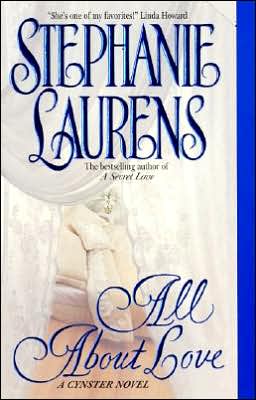
In All About Love the heroine is Phyllida, a woman who is "too old" not to be married, but is independent and fiesty. Pretty much stock Laurens. But I like heroines like that! And I like the fact that they "surrender" to the big bad Cynster man, in a way, because unlike others, I don't feel that the heroines always give up their independence to the men. So the heros are always protective. I kinda think that's a good thing. Authors might be stretching reality a little too far to expect us to believe that any woman from early nineteenth century England was able to maintain complete independence from her husband, especially when that husband is madly in love with her.
I guess I liked this book more than Shannon did, because I wouldn't give it a C-. Sure, there was way too many sex scenes, and the heroine's "Lady of the Vale" thing was kind of wonky, but I liked the relationship between the hero and the heroine. I also liked that they were able to live with each other quite peacefully and pleasantly long before the end of the book. That doesn't always happen in romance novels.
I really liked this book! It did remind me a little bit of A Secret Love in the sense that the hero and heroine had known each other from childhood, and the heroine was a woman considered to be a spinster past her prime that needed the hero's help to protect her family name from scandal, but who really cares, right? I liked that book, too.
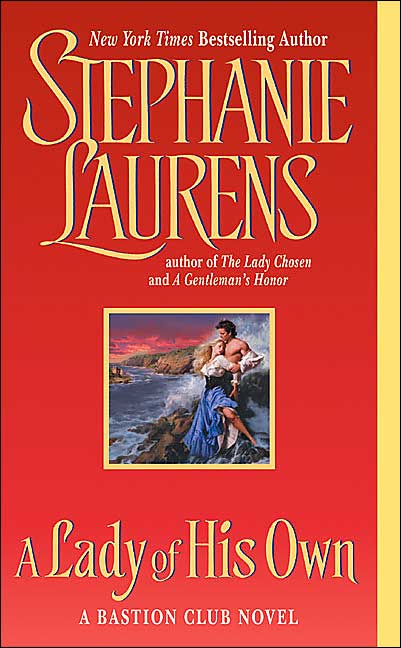
This book is not a Cynster book, but a Bastian Club book. It's kind of funny how I used to not like Stephanie Laurens very much, but now I really like her writing style. Maybe it's because she's Australian or something, but she doesn't write like other Regency romance authors. Her books remind me somewhat of Mary Balogh's books (a Welsh-Canadian) in the sense that they have a pretty serious tone to them. Julia Quinn, for instance, writes like her characters are modern day in the way they talk. And her tone is just very light and jovial. I used to like that a lot because it was fun, but you know what? Fun makes it more difficult for my emotions to become involved in the story.
So I appreciate that about Stephanie Laurens, that she takes her characters seriously , because it makes them more real to me. In A Lady of His Own, the hero, Charles, is a war veteren who actually spent his thirteen years of service as a spy in French, due mainly to his half-French heritage. Charles was the third son of an earl, so he never really expected to have to the responsibilities that came with the title. However, while he was in the military, both his father and his two older brothers died and thus he became the earl. Which means that he will have to get married and produce an heir in order for the title to continue in his family. But the women in London do not appeal to him as they are too flighty and shallow to be compatible with the man that spying and war has turned him into. When his superior at the Foreign Office asks him to go home to look into a smuggling ring in the area, Charles readily agrees. Once home, he runs into Phoebe, the daughter of his neighbor.
Charles and Phoebe have a long history together as they slept with one another before he left for war, when he was twenty and she was only sixteen. Phoebe has been in love with him for years, but she believed that she was nothing buy a dalliance to him. It is her love of him that has kept her from marrying in the thirteen years since they parted. It doesn't take Charles very long to figure out that Phoebe is mucking around in the smuggling mystery, and she confides in him that she believes her deceased brother was using the smugglers to send information to the French during the war.
The reason I liked this book so much was because Charles and Phoebe were such mature, responsible characters that it was hard not to like them. They were also very self-aware, which is not something that is often seen in romance novels. Phoebe knows that she loves him, and I was quite happy to see that she ACTED like a woman that was in love, i.e., she didn't try to constantly push him away. She always wanted to be with him, and she accepted his help. They were complete partners in their investigation into the mystery, which added greatly to the romance. I would highly recommend this book.
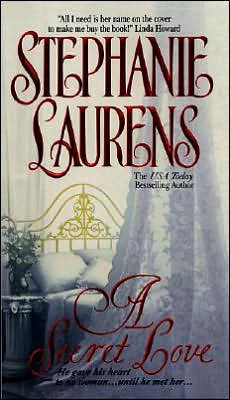
This book is the perfect example of how to include a heroine's insistence that the man tell her how he feels into a book, while my last review was definitely the opposite. In A Secret Love, the heroine Alathea is the eldest daugther of an impoverished earl who is the promissor to a promissary note which invests the entire worth of the earldom in a mysterious African mining company. Alathea's father may be impoverished, but society is oblivious to the family's financial troubles thanks largely to Alathea's devotion to managing the estate and the books. At twenty-nine, she is a spinster by society's standards because, shortly after her debut at eighteen, she discovered her father's debt and has since essentially sacrificed her life to helping her family and younger siblings. (I digress for a moment. Laurens is Australian, so does that explain why Alathea's apparently half-siblings were constantly referred to as her step-siblings? That annoyed the crap out of me!) Anyway, when she finds out about the note she is devastated, mainly because her two younger sisters are in London for their debut into society and a demand on the note would ruin the family and the girls' chances at making good matrimonial matches. Her only option is to challenge the validity of the mining company in the courts so as to nulify the note on grounds of fraud. But for that she could need help.
So she enlists the help of her childhood friend/nemesis, Gabriel Cynster, a member of the powerful Cynster family and cousin to the Duke of St. Ives. She and Gabriel do not get along as adults, but she knows him so well that she is able to present her problem to him and ask for his assistance in a way that so intrigues his sense of adventure and curiosity that he cannot deny her. Alathea does this by disguising herself as a mysterious countess who is always veiled when she approaches Gabriel, which also serves to protect her family's pride by not revealing that they are nearly penniless. Gabriel is intrigued, and also attracted to the young, shapely, tall countess. He helps her, but is also determined to seduce her.
What I liked best about this book was the deception Alathea pulled over Gabriel, who thinks he doesn't like Alathea while he is simultaneouslly sexually captivated by the countess. I thought that Laurens handled the reveal very well, and I was glad that she had Gabriel be sensible enough to realize that his feelings for the countess shouldn't go away just because he discovered that she is actually Alathea. And, although Alathea refused to marry Gabriel without hearing that he loved her, it worked in this sense because her hestitency to marry was completely believable. She was almost thirty years old, no one expected her to marry at all. I don't know, I guess it just makes more sense for a heroine to demand the words before she marries the hero, not bitch about it afterwards.
By far the best Stephanie Lauren's book I have ever read. Likeable hero, more than likeable heroine (I thought she was great). Coherent, interesting plot.
I'm not particularly a fan of Stephanie Laurens's books. Before this summer I had only read two of her books and neither one of them appealed to me. But Shannon must like something about her because she gave me three Laurens books recently:
The Truth About Love was just way too slow-paced for me. Everything moved at a snail's pace—the romance, the mystery, the day-to-day activities of the characters. I was bored to tears—because of that and because Jacqueline, the heroine, was so dull! I understand the reason Laurens characterized her the way she did, and it made sense, but it did not make for an entertaining read. Lindsey's Grade: C
What Price Love was an improvement over The Truth About Love in the sense that I was able to stay interested in the romance portion of the book. But the mystery was completely uninteresting to me and so I skipped over all of that. But again I was frustrated with the heroine because she constantly thrwarted the hero's attempts to make mention of marriage, even though they were well suited in all respects. I'm sooo tired of the cliched "I won't accept your proposal because I think you're doing it about of duty, not love" plot in romance novels. IT IS OVERDONE AND COMPLETELY UNORIGINAL! Lindsey's Grade: C+
To Distraction was such a relief after the previous two books! Finally I understood why Laurens is a bestselling author! I cared about the characters, cared about the mystery, and completely bought the way the book unfolded. And I was DELIGHTED to see that she didn't go for the cliched ending here. The heroine did exactly what I thought she should do at every point in the book, something that is very rare. And I particularly liked the way that the hero's true character was revealed to the reader. I felt like we learned about Deverell (the hero) the way Pheobe (the heroine) learned about him. At first he appeared selfish and arrogant, but as we got to know him more he turned into the perfect romantic hero. Such a treat. Also, there was one line that the hero thought that actually made me say "Aww" to myself. I liked that. Lindsey's Grade: A-
 Well, for the first time in Stephanie Laurens' Black Cobra quartet, the name of the book actually makes sense. (This was not the case in either The Untamed Bride or The Elusive Bride.) As it turns out, the heroine in this book was a little brazen.