Lately I have been thinking a lot about book series and what it is that makes a reader continue on in a series. I read a lot of romance novels and a lot of authors within the genre write in series, or at least have characters that are interconnected. What I am not sure about is whether I continue reading in a series because of some strange obligation I feel or because I genuinely like the writing and the stories.
I have to admit, sometimes I feel like I buy books just because they are the next one in the series. Even though I really like her books, sometimes I have felt that way about Lauren Willig's Pink Carnation series. I really liked The Seduction of the Crimson Rose, but I wasn't crazy about The Deception of the Emerald Ring. So what made me continue? Ultimately I think it was the contemporary story that Willig weaves and spreads out through all her books.
And there are some series that I have to read just because I love the writing and that makes me auto-buys for me. I know a lot of people don't like her, but Stephanie Laurens is like that for me. I don't care what the plot of a particular book is. If it's a Cynster or Bastion Club book, I'll buy it.
I do so many auto-buys on a familiar series that I was concerned that I'm being suckered into buying books that aren't very good just because I read the first one. So I was very pleased with myself when I finally, finally gave up on Eloisa James after Desperate Duchesses. I started out really liking her books, but the last two books before Desperate Duchesses didn't appeal to me at all. After reading the first in her Duchess series, I finally found the willpower to say "no more." It was hard, but I did it.
And then there are books like the Twilight series that I not only love, but I have to read so I can know what happens to the characters! It's very hard to put a series down when there is no real conclusion until the last one.
I'm trying to figure this all out because I'm contemplating continuing on with the vampire series I started out of curiosity/for experiement's sake. I have nothing else to read as far as novels go, at the moment. But I don't know if I should spend the money. I wouldn't mind hearing the stories of the other characters, but am I going to regret it if I commit to five more books?
So I guess I'm just curious--how do you approach series?
Friday, April 11, 2008


Book Reviews
I've read all these books in the past few months. And honestly, they were all pretty good. No major complaints.


Thursday, April 10, 2008
Book Review: Dark Lover

Since in the past I have ranted and raved about how much I hate the influx of vampire/paranormal stories into the romance genre, I was a little concerned that I had been too hasty in my condemnation when I discovered I loved a series of books about teenage vampires. So I decided to do a little experiment and yesterday I bought a vampire romance novel that is part of a series that has generated a lot of positive talk in the romance fan world.
Turns out, I'm still not crazy about vampires. The vampires in Dark Lover are very different from the ones in the Twilight series. Indeed, the whole vampire world is different.
I prefer the Twilight version.
Not that this book was bad. In fact, it was entertaining. But I couldn't help but think that I would have liked the vampire hero just as much if not more if he were human.
It's good to know that my original instincts were correct. Phew.
Monday, April 07, 2008
Book Reviews: Twilight, New Moon, Eclipse
 I never in a million years would have thought that I would write a raving review about teenage vampire books, but here I am. Perhaps you have heard of these books: Twilight, New Moon, and Eclipse. Apparently they are bestsellers. The last book in the series is Breaking Dawn and it comes out in August. I CAN'T WAIT!
I think that part of the reason I enjoy these books so much is because they are set in Forks, Washington, which is on the Olympic Peninsula for those of you that don't know. A lot of scenes also take place in La Push, and I've been to both places. I love, love, love western Washington so reading about these places that I know and like is pretty cool.
The main character in Twilight is a seventeen year old girl names Isabella (Bella) Swan. Bella has lived her whole life with her mother in Phoenix, but when her mom gets remarried to a professional baseball player who travels a lot, Bella moves to Forks to live with her father, Charlie. In Forks she meets Edward Cullen, an incredibly handsome seventeen year old who is the member of a mysterious family in town, the Cullens. It doesn't take long before Bella discovers that Edward and his family are, in fact, vampires!
But the Cullens are unique vampires. Their patriarch, Carlisle, "created' all of them and taught them to live a "vegetarian" lifestyle, which essentially means that they don't drink human blood, only animal blood. They still crave human blood, and as it turns out, Edward happens to crave Bella's blood even more than the average person. Which makes the fact that they fall in love with each other pretty interesting...
But there are other bad vampires out there in the world and when three of them wander into Forks and find Bella hanging out with the Cullens, they're intrigued. And one of them wants Bella. How far will the Edward and his family go to protect Bella, and will it be enough? Ooooohhhh....
 New Moon picks up a few months after where Twilight leaves off. This is actually my favorite of the three books that are out so far. Without giving too much away, I will say that there are some really interesting plot twists that occur in this book and that set up the rest of the series. Specifically worth mentioning is Jacob Black, a family friend of Bella's who is a sixteen year old member of the Quileute Indian Tribe in La Push. Tribal legend has told of members who turn into werewolves when vampires are around the community, as well of an ancient treaty between the tribe and the "vegetarian" vampires (i.e., the Cullens). Well, turns out the legends are true! And young Jacob turns into a werewolf, the mortal enemy of the vampires. How is Bella supposed to handle the feud between her true love, Edward, and her best friend, Jacob? Ooooohhhh.... (Tons of other important stuff happens, but I don't to give it away.)
 Now we get to Eclipse, the most recently published book. This book is hard to describe without giving too much away about New Moon. There are things about Eclipse that makes me not like it as much as the other two books, but at the same time Meyer does some stuff here that is pretty intriguing. I didn't like what she did, but you know, sometimes your characters have a life of their own and a writer can't really control it. Maybe Meyer planned it all out, but there's a part of me that thinks that a natural progression occurred beyond her control. Let's just say that things get pretty complicated for Bella here. Vampires, werewolves, true love... that's a lot for an eighteen year old to handle.
I can't say why I like these books so much. It's not the vampires because I'm still pretty ambivalent about vampires, but Meyer is just a good storyteller. I care about these characters and feel like I'm a part of their lives. And she's set things up so that there is a really compelling story going on here (partly because Edward is going to be seventeen forever and Bella is... not. Can you tell where this is going?) I don't know how she is going to wrap all of this up in Breaking Dawn but I already feel like she can go a number of different ways and still have it be satisfying.
My one little gripe about these books has to do with the romantic relationship between Bella and Edward, and especially the developments in New Moon. I understand that they love each other and all that, but look, I've been seventeen and in love, too. I too was convinced that it was going to be forever, but as it turns out, it wasn't. There's a part of me that is concerned about the message that these books send about teenage relationships, but I'm trying to ignore that because, well, one of the teenagers is a vampire that was born in 1901, so he's been around the block. Maybe it's possible to fall eternally in love when you're seventeen if the person you fall in love with is a vampire, because really, that's a pretty special circumstance. And heck, I'd be in love with Edward Cullen, too.
I am really getting into Young Adult books, now, I don't know why. I kind of think that I have a Peter Pan complex, though. Young Adult books, High School Musical movies and music, teeny-bopper films, The Disney Channel shows... What's wrong with me?
Thursday, March 27, 2008
Book Review: The Far Sweet Thing
 Well, I didn't enjoy this book as much as Rebel Angels, but I still liked it.
 In this third and final installment of the Gemma Doyle triology, Gemma is starting to come into her own as she is forced to deal with all the creates of the Realms since she is now the sole holder of the magic. (Sorry, that was a spoiler.)
There are some things that annoyed me in this book, too. Mainly all the time spent in the Realms and how Gemma was sooooo dumb for sooooo long about her friend Pippa. (I know, this review is useless to anyone who hasn't read the book. Oh well.) Part of the reason why I liked Rebel Angels so much is that most of the book took place in London instead of at Spence Academy, so there was a lot more going on. And there weren't really any surprises left for The Far Sweet Thing as most of those had been resolved in Rebel Angels. so I felt like I was just waiting to see what would happen for most of this book instead of being actively engaged in the story.
Anyhoo, that's all I have to say. Not a bad trilogy.
Book Review: Rebel Angels

(Hey! I'm back! Once I finished with that pesky Moot Court stuff I had time to read again!)
I read the prequel to this book, A Great and Terrible Beauty, over a year ago, and I bought this one not long after. But I wasn’t really crazy about the first book so I put off reading this one until just a few weeks ago. I was rather surprised to discover that I liked this one much more!
These books center around the life of sixteen (then later seventeen) year old Gemma Doyle around 1895. Gemma grew up in India with her British parents, but after her mother died a mysterious death she and her family moved back to England and Gemma was enrolled in Spence Academy for Young Girls. It is at Spence that Gemma starts having mysterious visions and learns about a group of women sorceresses called The Order. The background information is all set up in the first book, so maybe that’s why I felt it was dry. By the second book Bray was really able to delve into the secrets of The Order and The Realms (a magical world that only members of The Order are able to access).
There are a lot of things about Gemma that annoyed me at first--mainly that she has an uncanny ability to trust the wrong people. But the more I thought about it, the more I realized that is probably very true to life. A young girl without a mother who suddenly finds herself possessing magical powers and being hailed as the next High Priestess would probably be a little confused. Moreover, she is so young and faces so many tough choices and responsibilities that she was probably overwhelmed!
By the way, I should mention that these are YA (young adult) books, but I don’t really care. I AM STILL YOUNG ENOUGH TO READ YA WITHOUT SHAME, DAMN IT.
Anyway, if you like books that have magic and stuff you might like this series.
Wednesday, March 12, 2008
Book Links
The Pleasures and Perils of Chasing Book Thieves
Q & A with author Tracy Chevalier
The Fug Girls try not to discuss books. Their new book is out now.
An upcoming reading challenge. I'm thinking of trying at least one this year and this one may be it.
Q & A with author Tracy Chevalier
The Fug Girls try not to discuss books. Their new book is out now.
An upcoming reading challenge. I'm thinking of trying at least one this year and this one may be it.
Thursday, March 06, 2008
Booking Through Thursday - Hero
You should have seen this one coming … Who is your favorite Male lead character?
Well, I can say that I don't have any favorites. I rarely read books with male lead characters--sorry. I finished reading His Dark Materials and I enjoyed Will's character more than Lyra. His maturity level and common sense kept me interested in the book. If he wasn't introduced in book two I most likely would have stopped reading since I began to find the story dull.
I enjoyed reading Harry Potter and watching his character develop over the years. I remember struggling with his character development at times, thinking he was too selfish or overconfident, and realizing that it bothered me. I think it was the first time I had been so involved with a character, like a friend, that I was concerned.
Well, I can say that I don't have any favorites. I rarely read books with male lead characters--sorry. I finished reading His Dark Materials and I enjoyed Will's character more than Lyra. His maturity level and common sense kept me interested in the book. If he wasn't introduced in book two I most likely would have stopped reading since I began to find the story dull.
I enjoyed reading Harry Potter and watching his character develop over the years. I remember struggling with his character development at times, thinking he was too selfish or overconfident, and realizing that it bothered me. I think it was the first time I had been so involved with a character, like a friend, that I was concerned.
Wednesday, March 05, 2008
Tess of the d'Urbervilles by Thomas Hardy
 Tess of the d'Urbervilles by Thomas Hardy (1891)
First, check out the painting that was on the cover of my book. It alone caused me to want to read this book. She looks so sad. The painting, by Francis Danby, is called "Disappointed Love". I find it haunting.
I will admit that I am a thief. I have had a high school copy of this book since 9th grade Honors English. I can remember glancing at the book thinking it looks too hard to read. It's not. In fact I loved it. I'm actually surprised since I usually don't enjoy fiction, let alone classical fiction. Tess is hands down the most depressing character I have ever met in a book. Nothing goes well for Tess. She was deceived by a man at an early age and works so hard to bring herself out of poverty and despair, but soon finds herself back in it. I hated Angel Care, Tess's husband. I hated that he could have premarital sex and yet not forgive Tess for being raped as a teenager. Stupid men. I also despised him when he asked another woman to run away with him after not being able to forgive Tess. This was while still being married to Tess. Even though he doesn't go through with it he still is scum in my mind. Her rapist, Alec, also is a piece of work. A lot happens in this book and I don't want to ruin the ending for future readers **AHEM, LINDSEY AHEM**.
This is not a happy novel. It is the kind of book which makes you reflect upon humanity and a woman's role in society. It also reminds one to be grateful for what they have.
Kim's Grade: A
Monday, March 03, 2008
Almanac of the Dead update
Remember when I spoke about my reading goal for the year? Well, a correction is needed. The book is only 762 pages, not over a 1000 pages long. This surprised me because I've been able to speed through other lengthy books like Anna Karenina and the Harry Potter series. But this book takes forever.
First let me describe the layout of the book. There are six parts with a total of 19 books within the parts.
The first part takes place in the United States. We are in Tucson at Zeta's house where we meet several key(?) characters. Ferro is the son Lecha abandoned and Zeta claimed. He is obsessed with guns. Paulie is the attack dog caretaker and an ex-con. Lecha is addicted to Demerol, codeine and is a well-known psychic, dying of cancer.
Sterling, the gardener, left his rez and accidentally goes to Tucson. He subscribes to Police Gazette and True Detective magazines. He mentions the story of loss of the Stone Idols and the "finding" of them later in a museum. This loss has been difficult for his reservation. "Found" artifacts have always been an interesting argument of ownership. Should the artifacts be returned to the original owners? Or should they be kept on display? How can you even argue ownership? The dispute over how artifacts are given, sold, stolen, etc alone is questionable.
Lecha was returning to Tucson to get things in order before her death. She hired Seese to aid her in transcribing her old notebooks into a word processor and to act as a nurse if anyone should question the drugs or injections. Seese is a recovering(?) coke addict who takes the job because she wants Lecha (the psychic) to find her baby.
Sounds like a classic episode of Maury Povich if you ask me.
I have a feeling this one sentence has set up the rest of the novel, "Nothing happens by accident here". We shall certainly see!
First let me describe the layout of the book. There are six parts with a total of 19 books within the parts.
The first part takes place in the United States. We are in Tucson at Zeta's house where we meet several key(?) characters. Ferro is the son Lecha abandoned and Zeta claimed. He is obsessed with guns. Paulie is the attack dog caretaker and an ex-con. Lecha is addicted to Demerol, codeine and is a well-known psychic, dying of cancer.
Sterling, the gardener, left his rez and accidentally goes to Tucson. He subscribes to Police Gazette and True Detective magazines. He mentions the story of loss of the Stone Idols and the "finding" of them later in a museum. This loss has been difficult for his reservation. "Found" artifacts have always been an interesting argument of ownership. Should the artifacts be returned to the original owners? Or should they be kept on display? How can you even argue ownership? The dispute over how artifacts are given, sold, stolen, etc alone is questionable.
Lecha was returning to Tucson to get things in order before her death. She hired Seese to aid her in transcribing her old notebooks into a word processor and to act as a nurse if anyone should question the drugs or injections. Seese is a recovering(?) coke addict who takes the job because she wants Lecha (the psychic) to find her baby.
Sounds like a classic episode of Maury Povich if you ask me.
I have a feeling this one sentence has set up the rest of the novel, "Nothing happens by accident here". We shall certainly see!
Tuesday, February 26, 2008
Library of Lost Dreams
I'm behind in my reviews. Sorry. I do have an interesting story on an abandoned Detroit School Book Depository. Its worth reading and viewing the photographs. I was amazed.


Tuesday, February 19, 2008
The Feminine Mystique
 The Feminine Mystique by Betty Friedan 1963
I tried, I really did. I've wanted to read this book for such a long time and when I finally settled down to read it I found that I couldn't. I had difficulty getting into her use of language. We just don't talk like that anymore, nor do we read that way either.
Another issue I had was that Friedan was preaching to the choir. I understand her perspective. I still find her overall argument relevant today. I see women turning to Oprah, book clubs, gyms, shopping, cooking classes as ways of finding themselves. Granted this isn't the entirety of Friedan's message it is a portion of it.
I feel horrible that I couldn't finish this. I mean, I graduated with a BA in Women's Studies and I can't finish such a pivotal work in Women's Studies! Something must be wrong with me. There are just so many books I want to read that I've got to put my foot down at times in order to spend my time reading something else. Don't you ever find yourself doing that?
Sunday, February 17, 2008
Interview with Haruki Murakami
I received 14 books for Valentine's Day one of which is The Wind-up Bird Chronicle by Haruki Murakami. I've wanted to delve into his writing for some time now and have heard this is a good place to start. The plot sounds fascinating:
"The story begins with the disappearance of Toru Okada's wife's cat, which is immediately followed by the disappearance of the wife, herself. Mild-mannered Toru sets out to find out where they went and why. He discovers much more than he bargained for: a precocious teenager, a pair of psychic sisters, a haunted veteran of Japan's war in Manchuria, a perfectly corrupt politician, and a strangely appealing well in a neighbor's yard. In his quest, Toru only succeeds in raising more perplexing questions, but his discoveries do shed startling light on the roots of the Japanese malaise." (Powell's)
While surfing various Japanese pop culture sites I found an interview with Murakami. They are rare since Murakami is a very shy, private man. So here are the links to the four part interview. Its well worth the read.
Part 1
Part 2
Part 3
Part 4
"The story begins with the disappearance of Toru Okada's wife's cat, which is immediately followed by the disappearance of the wife, herself. Mild-mannered Toru sets out to find out where they went and why. He discovers much more than he bargained for: a precocious teenager, a pair of psychic sisters, a haunted veteran of Japan's war in Manchuria, a perfectly corrupt politician, and a strangely appealing well in a neighbor's yard. In his quest, Toru only succeeds in raising more perplexing questions, but his discoveries do shed startling light on the roots of the Japanese malaise." (Powell's)
While surfing various Japanese pop culture sites I found an interview with Murakami. They are rare since Murakami is a very shy, private man. So here are the links to the four part interview. Its well worth the read.
Part 1
Part 2
Part 3
Part 4
Tuesday, January 29, 2008
The Geography of Bliss
I want to read this book, but our library doesn't have it and I'm not about to spend 25 smacks on a book. I know, I'm cheap. I have enjoyed this review though, and its just enough to hold me over until I breakdown and buy it. The review was on Powell's Book Review of the Day. I love that site!
The Geography of Bliss: One Grump's Search for the Happiest Places in the World
by Eric WeinerThe Geography of Bliss: One Grump's Search for the Happiest Places in the World
A Review by Daniel Gilbert
In the last two decades, psychologists and economists have learned a lot about happiness, including who's happy and who isn't. The Dutch are, the Romanians aren't, and Americans are somewhere in between. Eric Weiner -- a peripatetic journalist and self-proclaimed grump -- wanted to know why. So with science as his compass, he spent a year visiting the world's most and least happy places, and the result is a charming, funny and illuminating travelogue called The Geography of Bliss.
From the Persian Gulf to the Arctic Circle, Weiner discovers that happiness blooms where we least expect it. Who knew that the long, dark Icelandic winter gives rise to a magical, communal culture that has done away with envy and sobriety? Or that the Thais so prize "fun" that their government has created a Gross Domestic Happiness Index to ensure they get enough of it? Or that Moldovans are miserable because they "derive more pleasure from their neighbor's failure than their own success"? Or that the wealthy citizens of Qatar lead pampered, joyless lives in a "gilded sandbox" while the poor citizens of Bhutan are cheerfully obsessed with archery tournaments, penis statues and feeding marijuana to their fat (and presumably happy) pigs?
But Weiner does more than report on the lifestyles of the delighted and despondent. He participates -- meditating in Bangalore, visiting strip clubs in Bangkok and drinking himself into a stupor in Reykjavik. These cultural forays are entertaining, but the real focus of his story is on the people he meets in cafés and on buses, the people who rent him rooms and give him directions, the people whose conversations, confessions and silences reveal the deep truths about their lands and lives.
Weiner asks an Icelander whether he believes in elves, and the man replies, "I don't know if I believe in them, but other people do and my life is richer for it," leading Weiner to conclude that Icelanders "occupy the space that exists between not believing and not not believing. It is valuable real estate." He meets a widower in Slough -- a small town outside London with little to recommend it -- who explains that he's thought about moving away but that in the end "you come home because this is where you live." Weiner realizes that when our relationships end, "the place is all that remains, and to leave would feel like a betrayal....He doesn't love Slough, but he loved his wife, loved her here, in this much-maligned Berkshire town, so here he stays." Memory, like bliss, seems to have its own address.
Weiner has studied the scientific literature on happiness, too, and weaves it into his narrative, which he leavens with a steady stream of clever quips. We learn that "Bhutan has made tremendous strides in the kind of metrics that people who use words like metrics get excited about" and that "hairpin turns, precipitous drop-offs (no guardrails), and a driver who firmly believes in reincarnation make for a nerve-racking experience."
Weiner, a correspondent for National Public Radio, is an American who unapologetically indulges his ethnic stereotypes ("Watching Brits shed their inhibitions is like watching elephants mate. You know it happens, it must, but it's noisy, awkward as hell and you can't help but wonder: Is this something I really need to see?"), but if you want to wag a politically correct finger in his direction, you'll have to stop laughing first.
Weiner's book is so good that its occasional flaws stand out in sharp relief. He is smart and funny but doesn't always trust his readers to know that, which leads him to step on his punch lines and belabor his conclusions. Sometimes, he settles for clichés ("Happiness is a choice") and platitudes ("Some things are beyond measuring") instead of reaching for richer and subtler insights. And while he expertly brings us into the lives of every stranger on a train, he plays his own cards close to the chest. He tells us a lot about his obsession with satchels, for instance, but only in passing does he mention that he's a father. After traveling so long and so far together, we should know him better than that.
One of the ineluctable laws of travel is that most companions are beguiling at the beginning and annoying by the end. Weiner's company wears surprisingly well. It takes a chapter or two to decide you like him, and another to realize that you like him a lot, but by the time the trip is over, you find yourself hoping that you'll hit the road together again someday. The Geography of Bliss is a journey too good to be rare.
Monday, January 28, 2008
Saturday, January 26, 2008
Book Review: Captain Jack's Woman
 Pretty much your standard Stephanie Laurens. I enjoyed this book. 'Nuff said.
Book Review: Shadow Music
 Well, one thing is for certain. Okay, two things. The first is that Julie Garwood's writing is just not the same as it was during the first half of her career. And by not the same I mean not as enjoyable. But the second thing is that despite the fact that I don't like her recent stuff, she is still much better at historical novels than contemporaries.
Shadow Music is Garwood's first historical since Ransom and her voice is just so much more better suited for this kind of book. I don't really want to write a long review, so I'll just say that this book is about a Highlander laird and an English lady (like most of her books). There were some things I didn't like about it, particularly how the romance seemed a little hurried, but overall I thought it was alright. It was coherent and interesting, in my opinion. But at the same time, I wouldn't have bought the hardcover if I hadn't have purchased it with a gift certificate.
Lindsey's Grade: C
Wednesday, January 23, 2008
Book Review: The Winter Rose
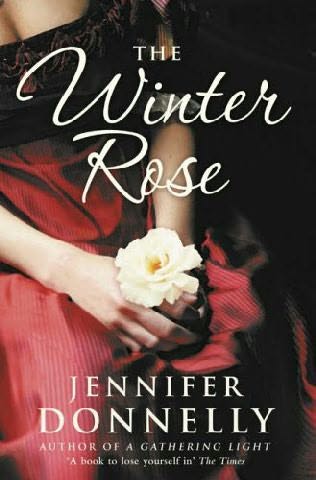 I'm not really sure how I feel about this book, honestly. I found the plot engrossing and the 700 pages went pretty quickly, but at the same time I had some problems.
This book starts in 1900 London with the graduation of India Selwyn Jones from a female medical school. She grew up in a wealthy, aristocratic family, but is somewhat estranged from her family because of her decision to pursue medicine. India is determined to make a difference in the poorer parts of London, particularly the East End, but once she starts working she realizes that she knows nothing about the people there. The high morals standards and health habits that she'd been taught and had been preaching didn't seem to have much place in Whitechapel. It takes a while for her to realize that, and she does it with the help of Sid Malone, the most infamous crime lord in the East End.
When India was young she lost the boy that she loved in tragic circumstances, so she is determined never to love like that again. That's the reason why she settles and accepts the proposal of her childhood friend, Freddie, a young MP who is blazing a trail for himself through Westminster. But Sid Malone makes her feel things that Freddie never did, and suddenly India starts to believe that Sid might be worth taking another chance on.
There is way, way more going on in this book, but I don't want to to give too much of it away. I was really impressed by the effort that went into the plotting, and Donnelly clearly has a real talent for coming up with gripping stories. But at the same time this book was filled with so many coincidences that it was just hard to believe all of them. After reading this book you would think that there were only a dozen people living in London's East End in 1900 because of the rather remarkable connections between all of these people. But I've read The Classic Slum. I'm pretty sure that wasn't the case. When those coincidences and connections start spanning the globe, it gets even more ridiculous, I thought. But hey, it is a novel, so I guess I can excuse that for the sake of entertainment.
My other complaint is Donnelly's writing style. I always hesitate to criticize the writing style of the authors I review because I know I could never in my wildest dreams do what they go, so who am I to judge? At the same time, there is something to be said about a writer who can tell you something without coming out and telling you in a sentence that looks like something a third grader would diagram (noun, verb, etc.). Donnelly isn't quite to that point in her own writing because there were so many blunt statements that lacked any kind of lyrical quality which I consider to be the mark of fine writing. This is only her third book and only her second adult novel (she wrote a YA novel as well). I really think my complaints in that department have more to do with that than anything else. I'm sure that a couple books down the road she will really have come into herself because this book shows a lot of talent.
So in conclusion, I'd say that this was an engrossing historical novel that I enjoyed reading, but it was far from flawless.
Lindsey's Grade: B
Tuesday, January 22, 2008
NPR and Nancy Pearl
Here is another NPR Book Lust interview with Nancy Pearl. I have always enjoyed her recommendations. I also like the idea that I could visit her when in Seattle.
Seattle librarian Nancy Pearl returns with another set of what she calls "under-the-radar" books — titles you really, really should be reading but haven't (yet). The latest batch features the story of three royal cousins, tales of wild animal adventures and a pun-filled picture book for younger readers. 


Seattle librarian Nancy Pearl returns with another set of what she calls "under-the-radar" books — titles you really, really should be reading but haven't (yet). The latest batch features the story of three royal cousins, tales of wild animal adventures and a pun-filled picture book for younger readers.
'King, Kaiser, Tsar'
King, Kaiser, Tsar by Catrine Clay, hardcover, 432 pages
Although I was vaguely aware of the interconnectedness of the European royal families, I never really appreciated quite how close they actually were until I delved into Catrine Clay's eminently readable biography, King, Kaiser, Tsar: Three Royal Cousins Who Led the World to War. Making excellent use of newly translated and recently discovered letters and other materials, Clay explores the events, both personal and public, that led up to World War I, focusing on the lives of the three cousins of her title: George, who became King of England, Nicky, destined to become Tsar of All the Russias after the death of his father, Alexander, and Wilhelm (known as William to his English relatives), who grew up to be the final Kaiser of Germany.
To what extent did the characters of these three men lead inexorably to the war? Of what significance were other, more impersonal, factors? Did the very forms of government in their respective countries make war likely, if not inevitable? As Clay makes clear, despite the physical distances that separated them as they were growing up, the three developed close relationships with one another. They spent vacations together, "visited each other's homes, played together, celebrated each other's birthdays, danced with each other's sisters, and later attended each other's weddings. They were tied to one another by history, and history would tear them apart." She comes to the conclusion that "the relationships between the three, their personal likes and dislikes, did indeed contribute to the outbreak of hostilities." This is an excellent choice for both fans of biography and history.
'Cold Comfort Farm'
Cold Comfort Farm by Stella Gibbons, paperback, 256 pages
Stella Gibbons' Cold Comfort Farm has the mixed blessing of being among the very few books that have been made into equally good films. But, even if you've seen the movie (with Kate Beckinsale and Rufus Sewell among the stellar cast of characters), don't let that deter you from reading the book (which, however good the movie, still has something more to offer) — it's quite simply one of the funniest satirical novels of the last century. When Flora Poste is orphaned at the age of 20, leaving her an income of a paltry hundred pounds a year on which to survive, she decides to go live with her relatives, the Starkadders, at Cold Comfort, their dilapidated, perennially failing farm in Sussex, located just outside the town of Howling.
There she discovers one extremely quirky family. Aunt Ada Doom, her mother's sister, has pretty much refused to come out of her bedroom for almost seven decades, ever since the day that she saw "something nasty in the woodshed." And Aunt Ada Doom's children and grandchildren are not much better. Flora's cousin Judith is depressed (well, who wouldn't be, in such a situation?), while Amos, Judith's husband, ignores the farm in favor of the hell-and-damnation preaching he does for the Church of the Quivering Brethren. Their three children, Seth, Reuben, and Elfine, are equally eccentric, each in his or her own way. Then there's Adam, the handyman, who uses a twig to wash dishes with and adores the cows he milks, whose names happen to be Graceless, Pointless, Feckless and Aimless.
Once Flora gets the lay of the land, so to speak, she decides that she could manage her relatives' lives better than they've been doing themselves — and she takes it upon herself to do so. How she succeeds — or not — in clearing Cold Comfort Farm of the gloominess and foreboding that envelops it (and whether we ever learn what it was that Aunt Ada Doom saw in the woodshed all those years ago) makes for a deliciously entertaining read.
'The Animal Dialogues'
The Animal Dialogues by Craig Childs, hardcover, 336 pages
I have long been a huge fan of Craig Childs' nature writing, and I was delighted to discover his newest offering, The Animal Dialogues: Uncommon Encounters in the Wild. This is a book to read slowly and savor, accompanying Childs one chapter at a time as he travels through the rain forest of Washington's Olympic Peninsula to the Arizona desert, from the mountains of Colorado to the rapids of the Colorado River, from Alaska to New Mexico, and sharing his experiences — vicariously, of course — with the animals he meets along the way. (I have to say that, for much of this book, I was in a state of extreme anxiety on Childs' behalf though he seems to have undertaken the (to me) daunting excursions described here with no more worry than I might feel, say, crossing a street against the light. At times, I felt there needed to be a warning label on the book: "Author is a trained professional. Do not try this on your own." But then, I have never claimed to be an outdoorsy sort of gal, and perhaps I was overreacting.)
There are sections on a wide variety of animal life: the Great Blue Heron and the Blue Shark, ravens, coyotes, camels, owls, and jaguars, to name just a few. If I had to choose my three favorite chapters, they would include the description of Childs' mostly futile attempts to get rid of the (uninvited) mice that are sharing his tipi (where he lived for quite a while) in the snowy Colorado mountains; his tense standoff with a mountain lion (even knowing, obviously, that the author survived didn't keep this part from being a heart-pounding experience for me); and his discussion of grizzly bears, which includes this marvelous description: "Most animals show themselves sparingly. The grizzly bear is six to eight hundred pounds of smugness. It has no need to hide. If it were a person, it would laugh loudly in quiet restaurants, boastfully wear the wrong clothes for special occasions, and probably play hockey." Pick the species you want to know more about and read on.
'I Capture the Castle'
I Capture the Castle by Dodie Smith, paperback, 352 pages
American readers probably know the British writer Dodie Smith best — if they know her at all — as the author of the book The One Hundred and One Dalmatians, which was made into the popular 1961 Disney animated film. (As entertaining as the movie is, the book is much better.) In I Capture the Castle, first published in 1948, 17-year-old Cassandra Mortmain begins her account of her family's life in a dilapidated castle with these lines: "I write this sitting in the kitchen sink." And write she does, all about her unpredictable, often irascible father, who published one critically acclaimed novel many years ago but developed a terrible writer's block and has been unable to produce anything since; her stepmother, Topaz, an artist's model who loves to commune with nature sans clothing; her older sister, Rose, who dreams of escaping the family's poverty; her younger brother, Thomas, who together with Cassandra schemes to get their father back to writing; and Stephen, the orphan (son of their deceased housekeeper) raised by the Mortmains. But when an American family moves into the estate next door, life for each of the Mortmains, as well as Stephen, changes in dramatic ways. Cassandra continues writing, through heartache and happiness, giving us a book that's perfect for any woman with even a scintilla of romance in their hearts, from the ages of 12 to 112.
'Wise Children'
Wise Children by Angela Carter, paperback, 240 pages
If it's true that, as Homer (and others) have said, "it's a wise child that knows its own father," then septuagenarian identical twins Nora and Dora Chance can be called wise. Unfortunately, as Dora relates in Angela Carter's Wise Children, she and her sister have never been able to persuade Melchior Hazard, the man they know to be their father (Grandma Chance told them), and the finest Shakespearean actor of the 20th century, to admit — publicly or privately — his paternity. Instead, he refers to them as his nieces, daughters of his twin brother, Peregrine, adventurer and bon vivant. (Just to complicate matters, Saskia and Imogen, the twin girls who believe that Melchior is their father, and vice versa — he was married to their mother, after all — are mistaken. They're actually Peregrine's daughters. Two other sets of twins in the Chance-Hazard extended clan also make brief appearances here. It's all somewhat like a play by Shakespeare or Oscar Wilde.)
Illusion and reality blend in this novel as it ranges from the vaudeville halls of the 1890s to Hollywood in the 1930s to the British home front during World War II, from the death of Dora and Nora's mother immediately following their birth to their singing and dancing childhood and adolescence under the benign, loving, and frequently inebriated eye of Grandma Chance. The last, priceless scene takes place at Melchior's 100th birthday party (which happens to be Dora and Nora's 75th birthday as well). Carter was a brilliant writer, and in this, her wickedly entertaining final novel before her untimely death at age 52, there are numerous quotable sentences to savor: Grandma Chance's toast as she downs a glass of the bubbly: "Champagne to all here, real pain to the other bastards," Dora's assertion that "comedy is tragedy that happens to other people," and "It is every woman's tragedy that after a certain age, she looks like a female impersonator."
'By George'
By George by Wesley Stace, hardcover, 400 pages
In By George, author Wesley Stace weaves together the life stories of two different Georges — one is human and the other is a wooden ventriloquist's dummy. In 1973, 11-year-old George Fisher, who comes from a long line of show-business folks, is sent off to boarding school because his famous actress mother is going on an extended tour starring in Peter Pan. George is heartsick at being separated from his adored mother, but he can't bear the thought of leaving his beloved 93-year-old great-grandmother, Evangeline, who once performed as a successful ventriloquist, and bequeathed that talent to her son, George's grandfather, Joe.
School is just as bad as George fears, until he's befriended by the headmaster and by the school's groundskeeper, who presents him with a how-to book on ventriloquism, a gift that will change the direction of George's life. Meanwhile, the wooden George relates his own experiences of working with George's grandfather, especially those years during World War II when the two, ventriloquist and dummy, were sent overseas to entertain the British troops. Neither of the two Georges is aware of the existence of the other, until a series of events brings them together and forces long-buried family secrets to come to light. This inventive novel rewards the reader with its intelligence, its wit, its poignancy, and its splendid writing. By George, I loved this book!
'Gimme Cracked Corn'
Gimme Cracked Corn and I Will Share by Kevin O'Malley, hardcover, 32 pages
You can always count on Kevin O'Malley for an entertaining picture book — his Little Buggy has long been a favorite of mine. But even by the standard of his past work, Gimme Cracked Corn and I Will Share is something special. In the spirit of the book and its barnyard setting, I'd go so far as to say that it's something eggstra special. Although it's clearly aimed at 6-, 7-, and 8-year-olds who are just beginning to appreciate the possibilities of language and the pleasures of playing with words, this groanworthy, pun-filled picture book will delight the grownups in their lives, as well.
"One night," the book begins, "Chicken had a dream. He dreamed that in a beautiful barn, buried under a great pink pig, was a treasure of cracked corn — all the corn that any chicken could ever want." When he tells his friend George, George says, "You must be yolking," and "What are you — a comedi-hen?" Nevertheless, when Chicken sets out the next morning to follow his dream, George agrees to go with him, explaining that he's been "feeling a little cooped up lately." An adventure, and further wordplay, ensues. Readers, young and old, will get every yolk and probably cackle with amusement as they follow Chicken and George's eggstrordinarily entertaining adventure.
'Fowl Weather'
Fowl Weather by Bob Tarte, hardcover, 306 pages
If you're longing for a book that will make you laugh out loud, then run, don't walk, to the nearest library or bookstore and pick up a copy of Bob Tarte's Fowl Weather. There are animal lovers, and then there are REAL animal lovers, and then there's a higher class altogether, consisting of Bob and his wife, Linda, among very few others. (Among the others is Gerald Durrell – don't miss his comic masterpiece, My Family and Other Animals.) Just take a look at the (much necessary) cast of characters listed at the front of the book; it includes some human animals, true, but it's primarily animals who are winged, feathered and furred.
Whether he's engaged in an altercation with a duck, dealing with a master gardener who doesn't know his flowers from his weeds, hand-feeding a spider, worrying over the health of Stanley Sue, an African Grey parrot, fretting over Bertie the Bunny's missing puff of a tail, extricating himself from a pesky former classmate who somehow knows the fate of everyone in their old elementary school, as well as unsavory facts about Linda's now long dead pig, Mrs. Piggle Wiggle, or trying to cope with his dad's death and his mother's growing dementia, Bob's tone is self-deprecating, humorous, and totally winsome.
Sunday, January 20, 2008
Book Review: A Tree Grows in Brooklyn
 A Tree Grows in Brooklyn by Betty Smith
People love this book. Even good people like those at the New York Public Library who named this one of the books of the century. The latter is what led me to read this book. I would also like to be able to say that I am somewhat versed in good literature. It took me awhile to get through. I found the plot somewhat slow. The story surrounds Francie's coming of age at the turn of the 20th century. In many respects it is similar to other coming of age books in that Francie struggles to learn who she really is in the midst of providing for her family.
I grew to identify with Francie in several ways. She stepped up to the challenge of helping her family instead of attending college. She kept her goal of a good education within focus even in times of hardship. She daydreamed and wrote stories that were never published. She was a voracious reader and lover of books. And she loved her troubled father.
In addition to identifying with Francie I found the description of Brooklyn in the early 1900's fascinating. The class structure, the marketplace, the types of labor mentioned led to a better understanding of the Brooklyn's economy up to WWI. The fact that Smith grew up in Brooklyn and drew upon her own experiences make this book all the better. I can definitely see why this would be an honored book of the century.
Kim's Grade: A A good, entertaining read for young women.
Subscribe to:
Posts (Atom)
